








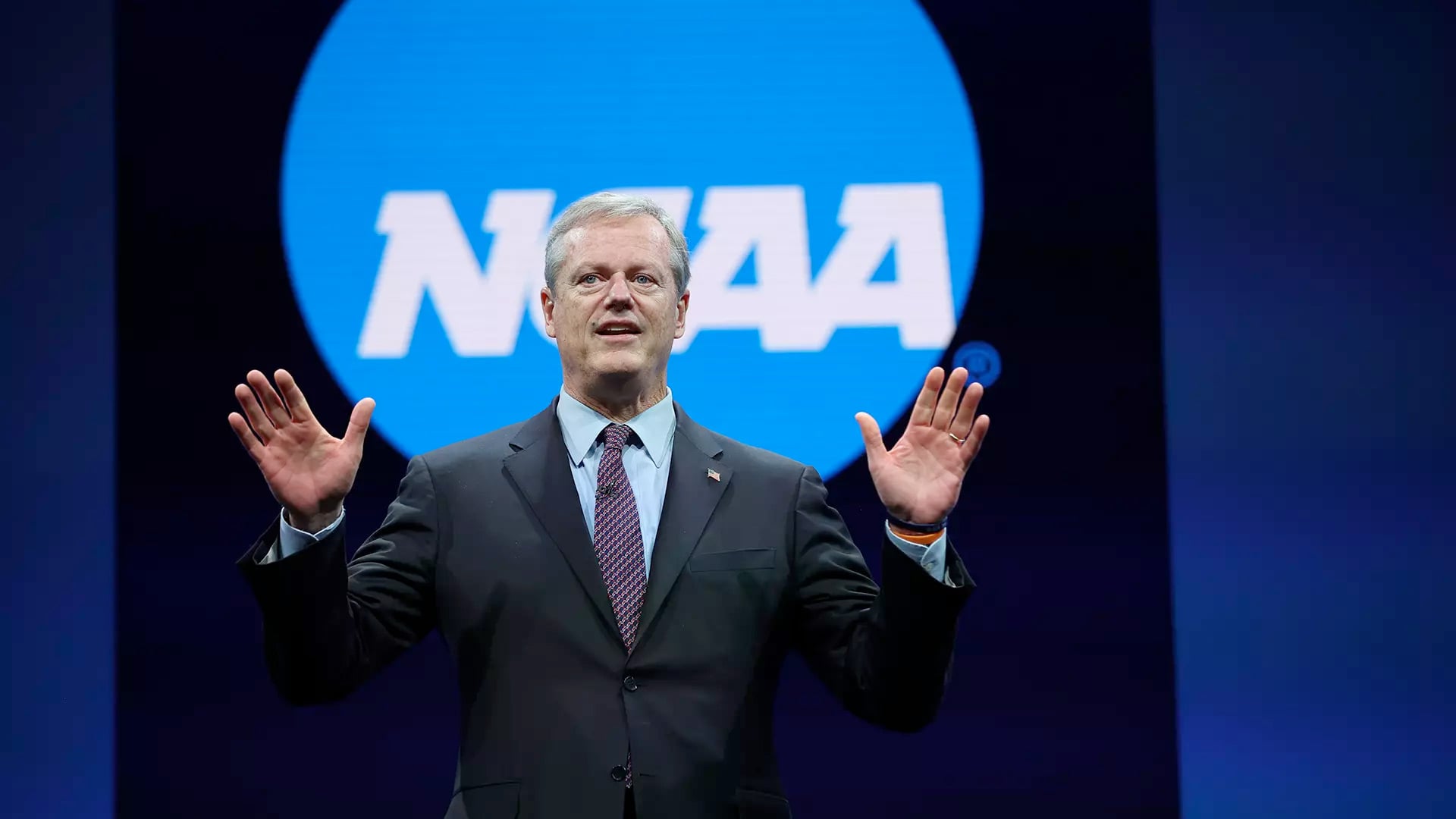
Prediction market operators said they can support “safe, fair, and transparent guardrails” after NCAA President Charlie Baker urged the Commodity Futures Trading Commission (CFTC) to suspend college sports event contracts.
“We look forward to engaging with President Baker and the NCAA to codify safe, fair, and transparent guardrails that protect players and consumers,” said a spokesperson for the Coalition for Prediction Markets, which comprises Kalshi, Crypto.com, Underdog, Robinhood, and Coinbase. “While we may not agree with the most sweeping approaches, we do believe we can find common ground that keeps fans protected and the market accountable — without pushing users toward unregulated, offshore alternatives.”
Baker, in a letter to CFTC Chair Michael Selig, asked the federal regulator to direct prediction market platforms it regulates to stop offering collegiate sports contracts until additional safeguards are developed and implemented.
“Protecting the well-being of student-athletes and the integrity of competition are of the highest priority to the NCAA, and the growth and haphazard nature of collegiate sport prediction markets pose a significant threat to both. I implore you to suspend collegiate sport prediction markets until a more robust system with appropriate safeguards is in place,” Baker wrote.
“The answer cannot be the status quo,” Baker added in a press release. “We need one set of fair, transparent standards.”
Baker said prediction markets function as financial instruments overseen at the federal level, leaving them outside state gaming regulator supervision and without common sportsbook safeguards. He wrote that regulated sportsbooks work with the NCAA on integrity-related matters, including suspicious activity reporting and cooperation with investigations, and said prediction markets should follow similar practices. Baker also said the NCAA should have a role in determining which markets are permitted.
Baker cited integrity monitoring and geolocation as gaps.
“While it appears that some monitoring occurs in prediction market trading, sport integrity monitoring is nuanced and requires heightened levels of review that don’t exist in many prediction markets,” he wrote. “For example, tracing the geolocation of bettors is often critical data in determining a sports integrity matter, but doesn’t appear to exist on prediction market platforms. There also don’t appear to be requirements for prediction market operators to report integrity concerns to other operators through a licensed intermediary to protect consumers.”
He also raised concerns that users as young as 18 can trade on sports contracts and said limits often imposed on sportsbook advertising near campuses do not apply to prediction markets.
“Given that some college students may erroneously equate sport prediction market trading to financial investing, it’s that much more critical that restrictions are in place,” Baker wrote.
Prediction markets began listing event contracts tied to game outcomes and player performance. Critics have argued that the contracts resemble unregulated sports gambling. Kalshi has said the products differ from traditional sports betting because there is no “house,” describing the activity as peer-to-peer trading.
Baker referenced recent controversy over Kalshi’s filing for self-certification of event contracts related to college athletes entering or withdrawing from the transfer portal, calling it “absolutely unacceptable.” Kalshi said it had no immediate plans to list those contracts.
Baker sent the letter two days after the American Gaming Association and the Indian Gaming Association urged the CFTC to take a firmer approach to sports contracts.
Baker’s request followed a federal indictment in the Eastern District of Pennsylvania alleging a college basketball point-shaving scheme involving several athletes on 17 NCAA Division I teams.
Original article: https://www.yogonet.com/international/news/2026/01/16/117186-ncaa-president-urges-cftc-to-halt-college-sports-contracts-amid-integrity-concerns