








In this article, B2B iGaming platform and sportsbook provider Turbo Stars explores how traditional affiliate models — from SEO to media buying — may be limiting long-term revenue potential, and why some traffic generators are beginning to consider the shift from affiliate to operator.
Every iGaming brand runs on traffic; this is a no-brainer. The people who generate, move, and price it are not just vendors — they’re a valuable part of the lifecycle. Without affiliates, most operators don’t have a business.
But here’s a question worth asking: what does affiliate traffic actually look like from the other side of the deal?
Working with operators across high-end regions, Turbo Stars sees traffic through the full lifecycle — from the first click to years of repeat deposits. And from that position, one thing becomes clear: the CPA payout is not the moment of value. It’s closer to the beginning of it.
What that means for the affiliate business model — and what it could mean — is what this piece is about.
The SEO affiliate ceiling
An SEO affiliate business is, at its core, an asset. Rankings take years to build, content compounds, and, with time, a well-structured network delivers consistent high-intent traffic — with a disproportionately high share of high-value players.
However, scale doesn’t address the structural issue of being a middleman. When operator demand drops, the affiliate absorbs the impact directly — budgets get cut, markets shift, and regulation tightens.
Better Collective, one of the largest affiliate networks in the world with €371M in revenue, laid off more than 300 employees in late 2024 after operators reduced marketing activity in key markets. The traffic didn’t disappear, but the demand did.
Their response was logical: expand horizontally into new markets, acquire more assets, and cover more ground. And that works — up to a point.
But there’s another way to look at it. If the traffic is the asset, the question isn’t only how to generate more of it. It’s whether you’re capturing the full value of what you already have.
The mediabuy margin trap
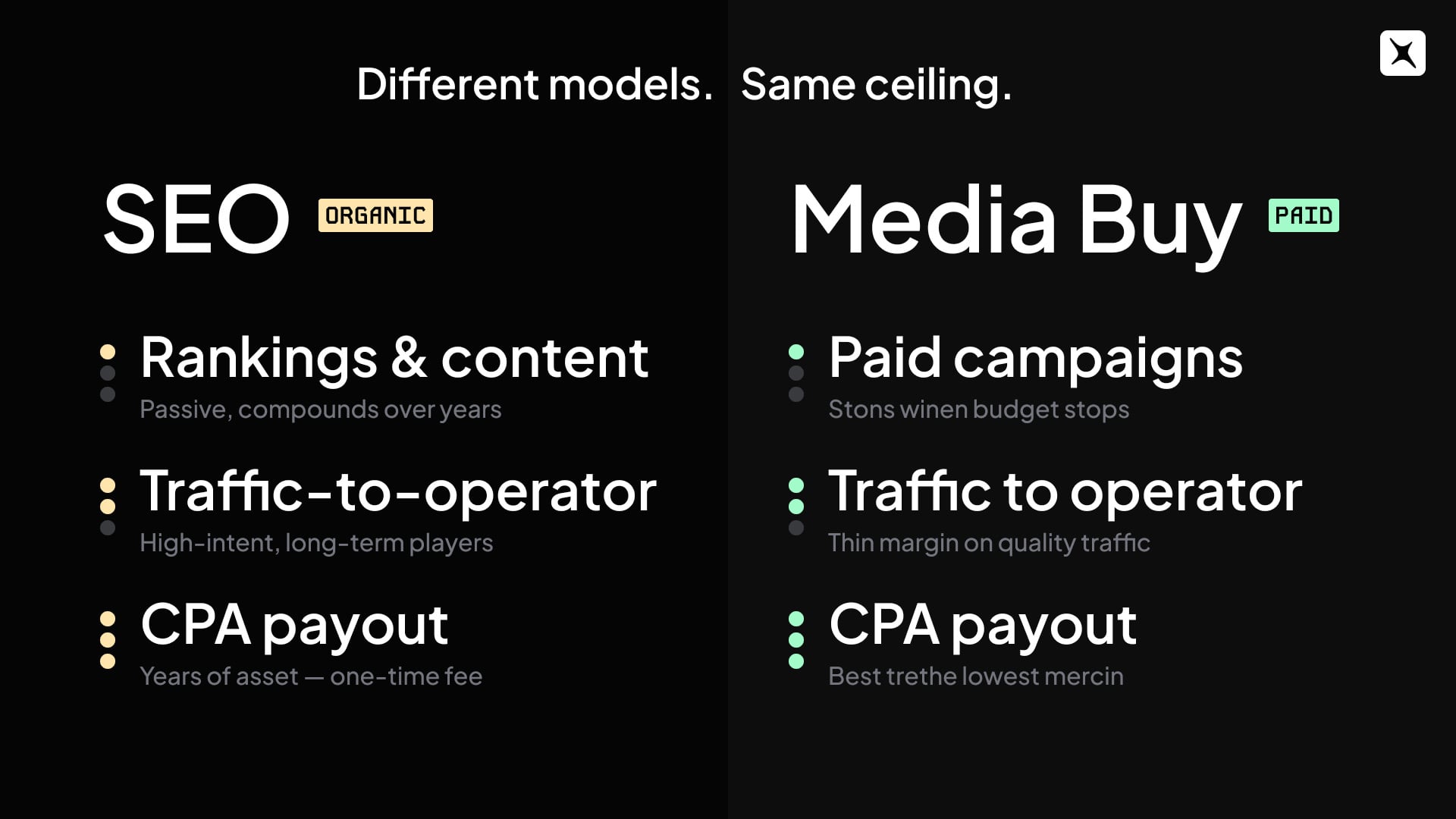
Where an SEO network generates traffic passively — rankings work while you sleep — a media buy operation runs only while the budget runs. No budget means no traffic, which means no revenue. The business doesn’t build equity; it either performs continuously or stops.
That creates a different kind of pressure. And it compounds the margin problem, which has no clean solution.
The margin on quality traffic is thin — acquisition costs eat most of the CPA payout.
Incentivized traffic is cheaper to run and earns a 50–60% margin, but operators won’t buy it indefinitely: retention numbers expose it quickly. The model becomes a blend of quality traffic to maintain operator relationships and incentivized traffic to keep the business profitable.
The problem is that this balance gets harder to hold every quarter. Traffic costs move faster than CPA rates. The margin on quality traffic compresses. The dependence on incentivized traffic grows.
But the quality traffic that earns 5–10% margin on a CPA deal isn’t low-value traffic. It’s the traffic that retains, redeposits, and compounds over time. The question is only whether it is monetized.

What CPA actually buys
Both models — SEO and mediabuy — share a similar underlying dynamic.
The SEO affiliate trades a long-term asset for a one-time payout. The media buy team trades its best traffic at the lowest margin. In both cases, the transaction closes at the moment of the first deposit. Everything after that belongs to someone else.
That “everything after” is where the economics of iGaming actually live.
A player who makes a first deposit doesn’t stop there. They come back — sometimes for months, sometimes for years. Each session, each redeposit, each losing streak compounds into a revenue relationship that looks nothing like the CPA fee that started it. The operator who paid that fee understood this.
Affiliates who understand it too are in a position to do something about it.
The model is straightforward: run the same traffic through your own brand instead of selling it. Acquisition becomes an internal transfer — the only cost is what it actually took to generate the player, not what someone else was willing to pay for them. What replaces the CPA payout is the full revenue timeline of every player who stays.
The accessibility of lifetime value
On the surface, the idea may seem overwhelming and complicated. However, the operational side of this is more accessible than it used to be.
A platform provider handles the infrastructure — payments, compliance, engagement, and retention features, as well as its technical integration. What’s left for the affiliate is the brand layer and the traffic they already know how to generate. The core competency doesn’t change much, but the destination of the revenue does.
For affiliates who’ve spent years mastering traffic generation, this is a legitimate path to a different scale of business — one where the revenue compounds instead of resets, and where the next operator budget cut is someone else’s problem.
The only real variables are appetite for change and willingness to operate outside a familiar model. The economics of why it makes sense are already in the numbers above.
Turbo Stars is a B2B iGaming platform and sportsbook provider designed for operators entering new markets, scaling existing brands, and seeking a reliable technology partner. Fast deployment, native sportsbook integration, and the infrastructure affiliates need to run their own brand — without building from scratch.
Original article: https://www.yogonet.com/international/news/2026/03/11/117990-the-affiliatetooperator-playbook-when-cpa-caps-the-revenue