








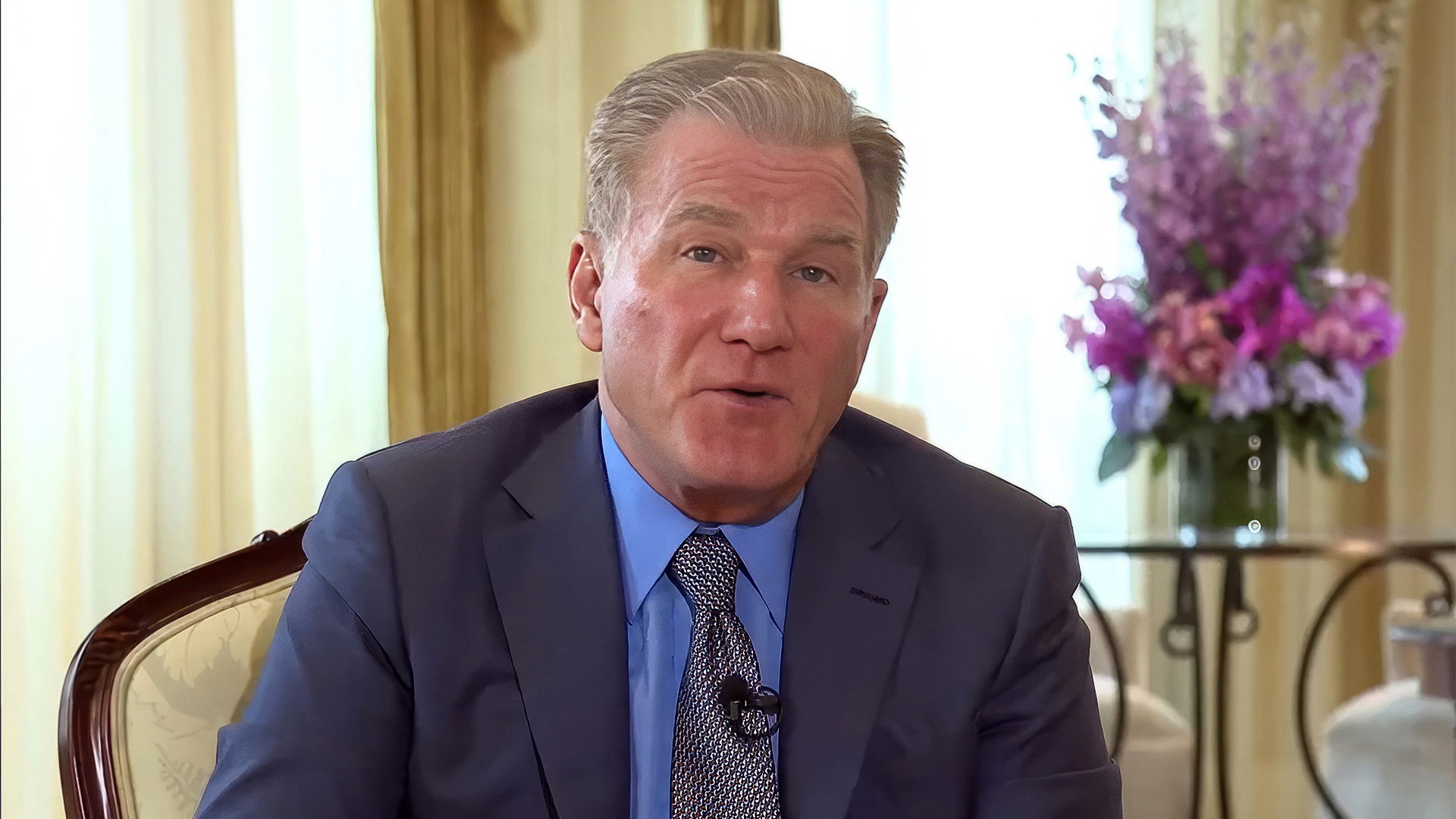
Las Vegas Sands (LVS) Chairman and Chief Executive Robert Goldstein said the company’s Macau operations are under pressure from rising competition, muted consumer spending, and the lingering effects of U.S.-China trade tensions, as gross gaming revenue in the region remains flat at around $28 billion annually.
Speaking at the Bernstein 41st Annual Strategic Decisions Conference, Goldstein noted that visitor numbers have rebounded in Macau, but that has not translated into higher spending.
“Spend is different than it used to be. Visitation used to be equivalent to the spend, but they’ve decoupled now, where visitation can be pretty good but the spend isn’t,” he said.
Sands China, LVS’s Macau subsidiary, has been hampered by ongoing renovation work and what Goldstein called underperformance relative to rivals. In the first quarter of 2025, Macau’s net revenue dropped 5.6% year-on-year to just under $1.71 billion, while adjusted property EBITDA fell 12.3% to $535 million.
“We’ve not done as well as we could have done competitively, and our last quarter was disappointing,” he said. “So, we’re hoping for improvement in our operating philosophy and approach to accelerate our own EBITDA.”
Goldstein emphasized the need for more direct customer incentives, suggesting the company must adapt its strategy even if it means thinner margins.
“We need to be more aggressive in Macau and make more money. No one pays you for margins or pretty buildings if they don’t produce EBITDA,” he said.
Despite near-term challenges, Goldstein reiterated his long-term confidence in the market, forecasting annual GGR of $32 billion to $34 billion. However, he acknowledged that such growth is unlikely in the immediate future.
“It’s not happening imminently, it’s not happening today or tomorrow,” he said. “We just have to wait for a better day in Macau and also help ourselves by performing better, by operating better.”
Goldstein attributed weak consumer sentiment to a confluence of macroeconomic pressures, including tariffs, the demise of the junket segment, and the expansion of online gambling in Asia.
“Macau is definitely stalled out, and it’s not where it was pre-COVID. The demise of the junket segment didn’t help either, and of course, the competition is fierce there,” he said.
He also pointed to broader geopolitical concerns, particularly strained relations between the U.S. and China.
“The world is in an awkward place right now, and there is confusion about the bilateral relationship between China and the US,” Goldstein said. “It needs to be stronger because the whole world benefits when China and US work things out together.”
Goldstein is scheduled to visit Macau in the coming days to review operations and identify ways to improve EBITDA performance.
Meanwhile, LVS’s Marina Bay Sands property in Singapore continues to perform strongly. “Our business in Singapore is powerful and … it’s based on a very top tier, luxury segment of customer,” he said.
Las Vegas Sands is the largest investor in Macau, but Goldstein acknowledged returns have not kept pace with the group’s capital outlay.
“We believe long-term that in the end, great buildings drive returns and we will be rewarded for the investments we have made,” he said.
LVS is banking on a stronger performance from the recently renovated The Londoner Macao, with Goldstein saying the company expects strong Q2 2025 results.
Original article: https://www.yogonet.com/international/news/2025/05/30/106514-lvs-ceo-robert-goldstein-flags-flat-macau-gaming-market-calls-for-aggressive-strategy-shift