








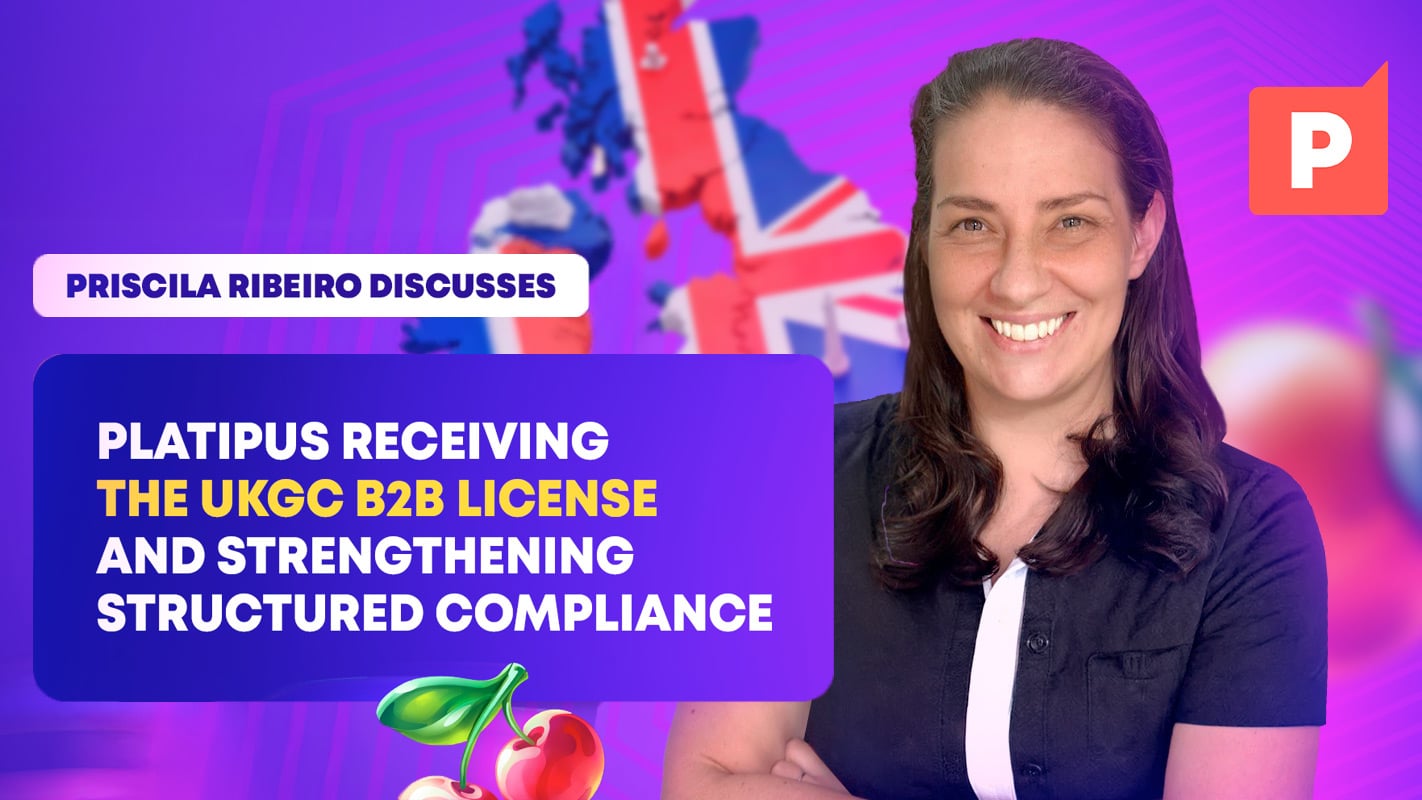
Platipus Gaming has officially received a B2B supplier licence from the UK Gambling Commission, marking a significant step in the company’s development within regulated markets. For Priscila Ribeiro, the milestone is less about market expansion and more about operational validation.
In this feature, Ribeiro outlines why the UK licence represents structured compliance, internal discipline, and long-term readiness rather than a short-term commercial announcement.
A licence as an operational benchmark
According to Priscila Ribeiro, Chief Strategic Officer, the UK remains one of the most structured regulatory environments for B2B suppliers.
“The UKGC framework is highly detailed and process-driven. It requires documented controls, ongoing reporting, clear governance structures, and supplier accountability. Receiving the licence confirms that our internal systems are aligned with those standards,” she explains.
Preparation for the licence involved cross-functional coordination across compliance, legal, technical, and operational teams. It required formalising procedures, strengthening documentation, and ensuring that risk management processes were not only implemented but auditable.
“This is not about adding a badge to our website. It is about demonstrating that our operational architecture can withstand scrutiny in one of the most demanding jurisdictions.”
Compliance by design, not by obligation
Ribeiro emphasises that structured compliance has been embedded into Platipus’ development lifecycle rather than treated as a final approval stage.
“In regulated markets, compliance cannot be retrofitted. It must be integrated into product design, QA, release management, and reporting workflows. The UKGC licence validates that our approach is systematic and ongoing.”
She notes that regulatory expectations increasingly focus on supplier responsibility. This includes technical integrity, data transparency, governance clarity, and the ability to demonstrate consistent oversight.
For Platipus, the licensing process reinforced internal alignment and strengthened long-term discipline rather than introducing temporary adjustments.
Reducing regulatory exposure for operators
One of the key implications of the UKGC licence is its impact on operator partnerships.
“Operators in regulated markets are under continuous supervision. They are increasingly selective about their suppliers because third-party risk directly affects their own regulatory standing,” Priscila Ribeiro says.
By working with a UK-licensed B2B supplier, operators gain greater predictability. The due diligence process becomes more structured, onboarding is clearer, and regulatory exposure is reduced.
“This is about stability. Operators want partners who understand regulatory accountability and can support sustainable supply, not just content distribution.”
Institutional maturity and governance
Priscila Ribeiro also frames the licence as confirmation of institutional maturity.
“The UKGC does not assess marketing claims. It evaluates governance, accountability, financial controls, and operational integrity. Receiving this licence signals that our internal structures meet a high regulatory threshold.”
She highlights that structured governance is becoming a competitive filter in regulated markets. As oversight intensifies across Europe and beyond, suppliers must demonstrate not only product quality but organisational discipline.
Looking ahead
While the UK licence strengthens Platipus’ position in regulated environments, Ribeiro stresses that it represents continuity rather than transformation.
“This milestone reflects the way we already operate. It reinforces our commitment to structured compliance, transparent processes, and long-term partnerships. Regulation should not be seen as a barrier to growth, but as a framework for sustainable collaboration.”
For Platipus Gaming, the UKGC B2B licence confirms operational readiness, structured governance, and a compliance-first approach designed to support operators in increasingly complex regulatory landscapes.