








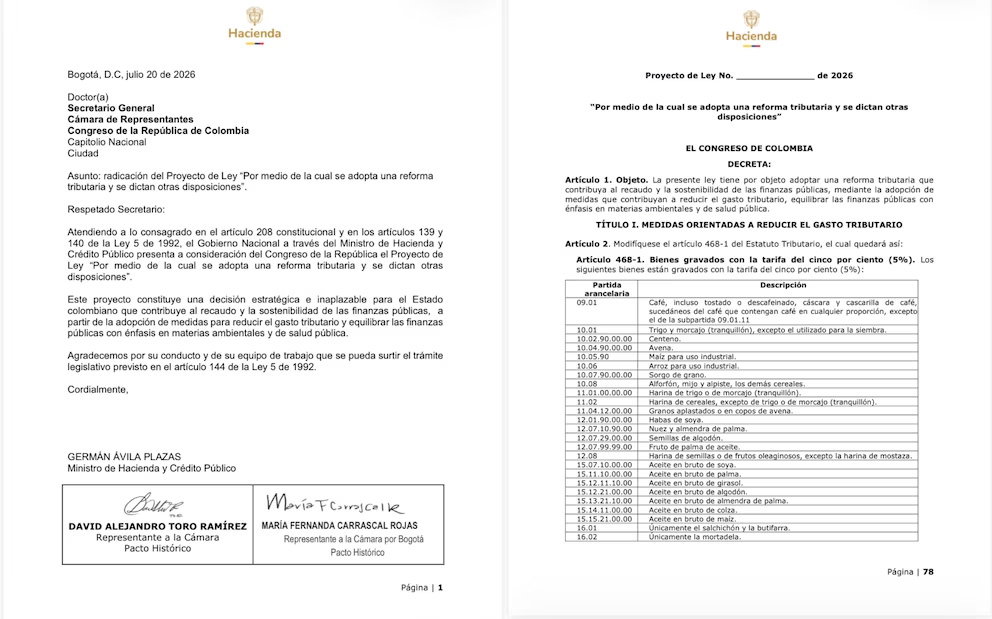
President Gustavo Petro’s government introduced its fifth tax reform proposal just days before the end of its term. The measure aims to raise COP 21.8 trillion (USD 6.75 billion) in 2027 and proposes making the 19% Value Added Tax (VAT) on games of chance operated over the internet permanent.
The objective of the tax burden on the sector is to generate tax revenue close to COP 1.7 trillion (USD 526,500) in the upcoming fiscal year.
“According to National Government estimates, taxing online games of chance would generate tax revenues of around COP 1.7 trillion in 2027 and would have no direct inflationary impacts on the economy,” reads the document filed on July 20, the day a new legislative session began in Colombia.
As published by media outlet La República, the Executive branch considers the measure applicable because online gambling is not part of the basic consumer basket for families. On the contrary, its impact on tax administration and public investment financing would be very positive.
“Equalizing the tax burden on games of chance between land-based establishments and those operated online will help finance the budget in 2027, contribute to increasing tax collection permanently, and will not have major effects on price levels,” states the text submitted by the Executive.
For the Government, without this proposal, digital services would receive “preferential treatment” compared to those offered in physical establishments. Levying VAT on this industry would eliminate distortions between face-to-face and online gambling, bridging the gap.
Finance Minister Germán Ávila discussed this when presenting the proposal: “Applying VAT at the general rate to online platforms reduces the differential treatments that have been granted to the consumption of goods and services which, in many cases, lack justification based on the principles of progressivity, horizontal equity, efficiency, and simplicity that must be guaranteed in the tax system as established by the Constitution.”
In the document, the Government also assured that the online games of chance industry has recorded solid growth in its betting revenue in recent years, even after the same tax measure was temporarily implemented due to the state of internal disturbance in 2025. Thus, it reported that as of June last year, gross betting revenue increased by 20%.
It is worth recalling that the current administration has presented several tax reform bills that have included taxes on the gambling sector, but ultimately failed to gain approval in Congress.
Additionally, it has included taxes on gambling through decrees, but the Constitutional Court declared Decree 1474 of 2025 unconstitutional—which provided for the imposition of a 19% VAT on gross gaming revenue (GGR) for online gambling—and ordered the refund of the money collected while the measure was in effect.
The new initiative now seeks to make permanent the measure for the gambling sector, which had a temporary nature in previous proposals.