








Caesars Entertainment narrowed its second-quarter net loss as growth at its regional casinos and higher gaming revenue offset weaker results from its Las Vegas operations. Net revenue increased 3% to $2.99 billion from $2.91 billion in the comparable period of 2025. Revenue had already increased during the first quarter.
Gaming revenue rose to $1.75 billion from $1.66 billion, while hotel and food and beverage revenue recorded slight declines. The company’s net loss decreased to $62 million, or $0.30 per share, from $82 million, or $0.39 per share, a year earlier.
The revenue increase did not extend to consolidated adjusted EBITDA, which declined 3.7% to $920 million from $955 million. Truist Securities analyst Barry Jonas said the result was below consensus estimates, although net revenue was in line with Truist’s forecast and above the consensus.
Regional casinos accounted for most of the company’s growth. Revenue increased 9.4% to $1.57 billion from $1.43 billion, while adjusted EBITDA rose 11.2% to $488 million from $439 million. The segment recorded $23 million in attributable profit after posting an $11 million loss in the prior-year period.
The regional comparison included Caesars Windsor, which moved from the company’s managed division into its regional segment after Caesars assumed full operating responsibility for the Ontario casino on March 3. The company acquired the operating assets for approximately $54 million and entered into a 20-year agreement with the Ontario Lottery and Gaming Corporation. The addition reduced direct comparability with the previous year.
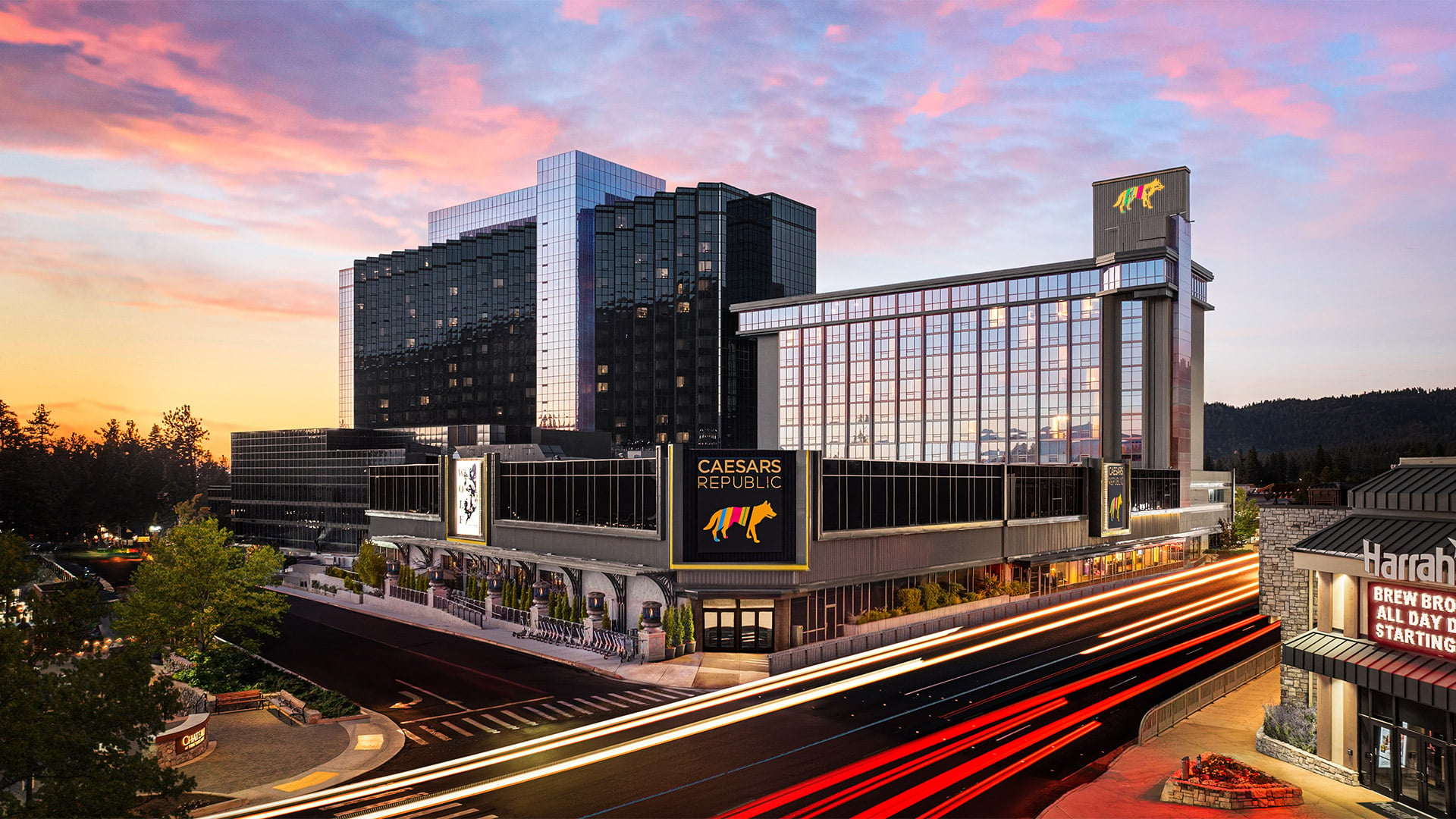
Caesars Republic Lake Tahoe
Jonas attributed the regional EBITDA increase primarily to the aforementioned consolidation of Caesars Windsor, but also to higher visitation in Reno connected with a bowling tournament, and revenue generated by recent capital investments in Lake Tahoe and New Orleans. Casino executives have also cited customers choosing properties closer to home instead of traveling to Las Vegas, a trend discussed by Boyd Gaming recently.
However, “Caesars’ stated margins (31.1%, +50 basis points year-over-year) were flat, as higher labor costs and gaming taxes offset higher revenues,” Jonas said.
Las Vegas remained the company’s main area of weakness. Revenue declined 3.5% to $1.02 billion from approximately $1.05 billion, while adjusted EBITDA fell 12.6% to $410 million from $469 million. Attributable profit decreased to $156 million from $212 million.
Table hold on the Las Vegas Strip was 16.6%, marking the first quarter below 17% since the fourth quarter of 2022. Table drop declined 5% to $706 million, compared with a 1% increase across the market.
“Caesars’s table weakness (on the Strip) was partially offset by increases in slot handle, up +5.4% year-over-year and in line with the market,” Jonas said. “Hotel occupancy of 95.5% was down 130 basis points year-over-year versus the market flat.”
Jonas described regional operations as “a bright spot,” while saying “the Strip was soft.” Las Vegas adjusted EBITDA was below consensus expectations, while regional adjusted EBITDA exceeded forecasts.
Caesars Digital generated $351 million in revenue, an increase of 2.3% from $343 million a year earlier, but below the record first-quarter total of $374 million. Adjusted EBITDA declined 15% to $68 million from $80 million, remaining close to the $69 million reported in the first quarter.
Online sports betting revenue decreased 3% year over year despite a 3% increase in handle. Hold fell 50 basis points to 8.4%, and Caesars cited higher online sports betting taxes as another negative factor. In contrast, iGaming revenue increased 11% to $188 million, with handle rising 3% to more than $4.8 billion.
Caesars ended June with $11.81 billion in aggregate principal debt, down from $11.91 billion at the end of 2025. Cash increased to $965 million from $887 million, reducing net debt to $10.84 billion. Cash and available borrowing capacity totaled $2.93 billion. The cash figure excluded $112 million in restricted cash.
LINQ Promenade
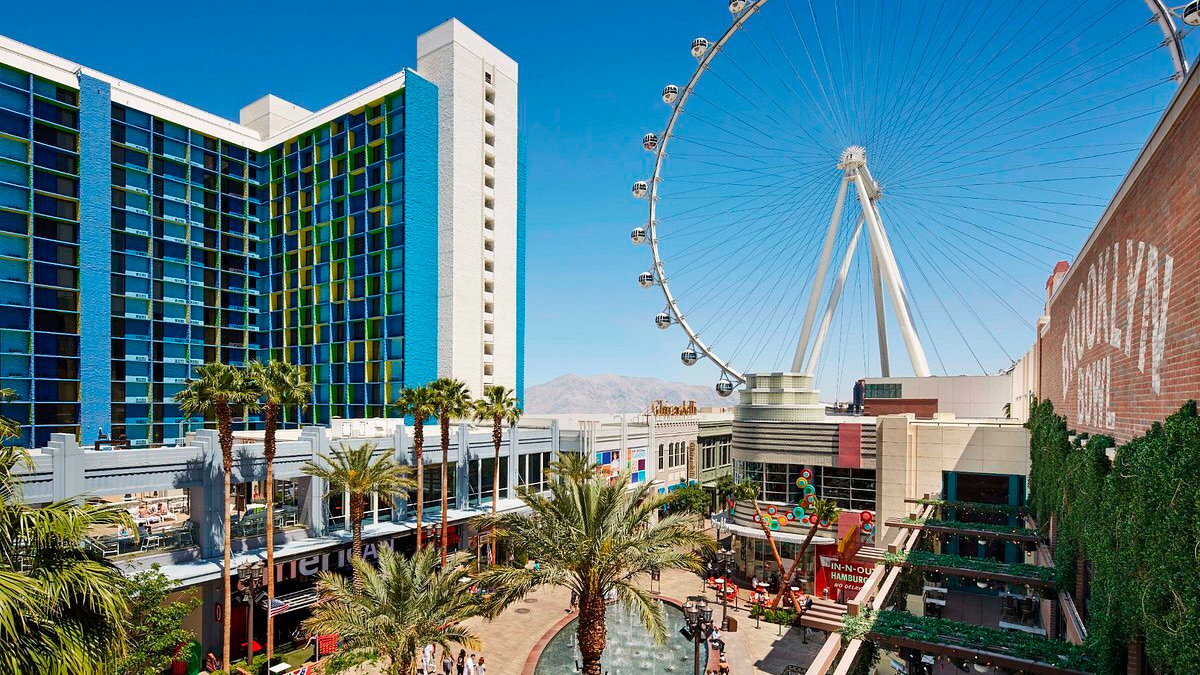
The company has also continued selling assets and reducing debt. Caesars sold the World Series of Poker brand for $500 million in October 2024 and the LINQ Promenade for $275 million that December. It used $500 million from the proceeds to repay debt.
Caesars’ pending acquisition by Fertitta Entertainment, a proposed all-cash transaction, is valued at $17.6 billion, including assumed debt, and assigns an equity value of approximately $5.7 billion. Shareholders would receive $31 in cash for each share.
The transaction remains subject to shareholder approval, gaming clearances and other regulatory consent, with completion expected next spring. Upon completion of the transaction, Caesars’s common stock will no longer be listed on NASDAQ, and the company will become a private entity.
Fertitta Entertainment executives have told Nevada regulators that their casino operations would be integrated into Caesars’ existing structure. Fertitta Entertainment has seven casinos, three of them in Nevada. The others are in Colorado, Louisiana, Mississippi, and New Jersey.
The current Caesars Board of Directors would be replaced by a Board of Managers composed of Fertitta executives.
Sonia Vermeys, Nevada-based gaming counsel with Brownstein Hyatt Farber Schreck, told regulators that Caesars’ existing executive and management team would continue running day-to-day operations.
Original article: https://www.yogonet.com/international/news/2026/07/29/125618-caesars-narrows-loss-in-q2-as-regional-growth-offsets-las-vegas-decline-ahead-of-fertitta-takeover