








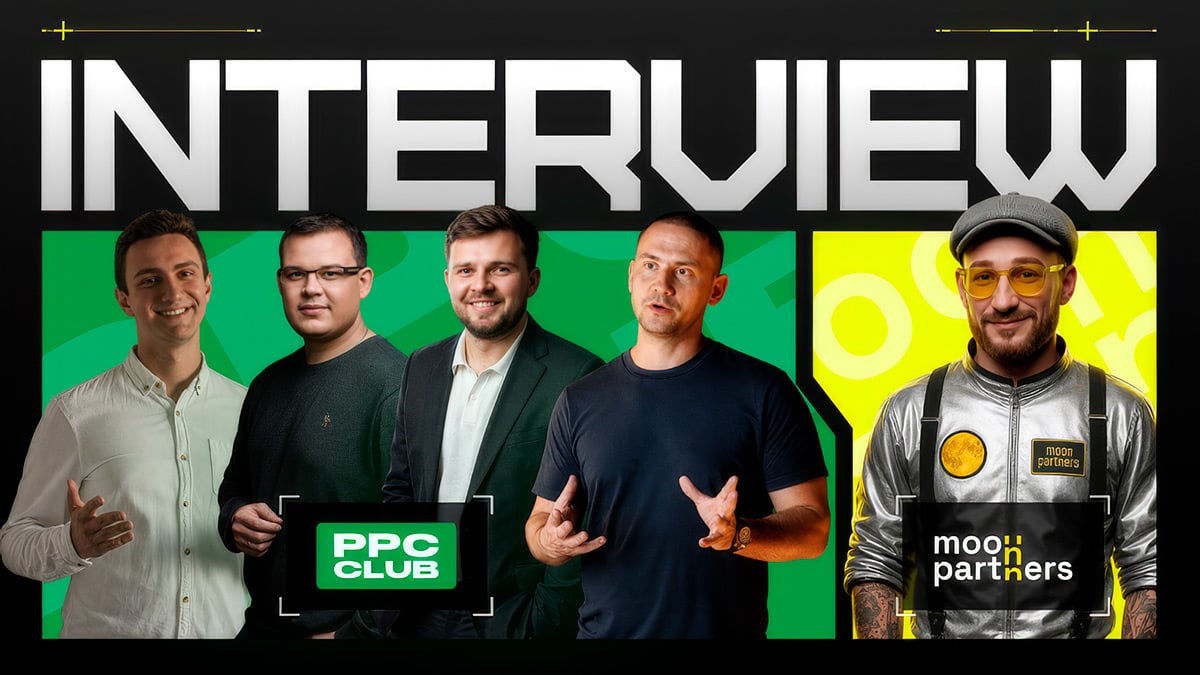
Trust is the foundation of any working relationship, and in performance marketing doubly so. Everything changes on the fly, and in that kind of turbulence it’s especially important to know you can rely on your partner.
This interview with Moon Partners and PPC teams unpacks the affiliate-program-and-PPC-team dynamic: how trust gets built, how to get great results and keep the partnership going long-term at the same time.
You often talk about long-term partnerships. So where does a good collaboration with a PPC team start for you, what has to click at the very beginning?
Maksym, Head of Affiliates, Moon Partners: For me, it starts with open communication and being on the same page about the goals. I like it when teams ask about the terms, when we go through the details of how we’ll work together and then actually stick to what we agreed. We pay attention to how a team thinks, what strategies they go for, whether they bring anything creative to the table.
It’s always a pleasure working with people who know the market and know their stuff. But the technical side is only half of it. The human side matters just as much: how a team communicates, whether they’ll talk things through, how quickly they come back to you. What clicks at the start is that balance, on the technical side and the human one.
When you’re picking which affiliate program to run traffic for, what do you look at first, the terms or how easy the team is to work with?
Vadim Eidlin, Co-founder & CEO of Mamuta Media: The first thing we always look at is the product itself. You can agree on great terms and get a high CPA or Revenue Share, but if the product isn’t right for that particular GEO, the numbers still won’t add up. What really matters to us is that a partner has all the payment methods the market needs, decent localization, a solid product, and generally everything it takes to convert PPC traffic properly.
Then come the deal terms. We work almost exclusively on a Hybrid model, CPA + Revenue Share, because we want to earn not just on the first deposit but on the player’s long-term value too.
After that, it’s the technical and operational side. While our BizDev is closing the deal, sorting out tracking, postbacks, attribution, caps and everything else, you usually get a fairly good sense of how easy the team will be to work with.
Mind you, at the start pretty much every advertiser is lovely, friendly and completely up for it. Especially once we start bringing in FTDs and they see the traffic quality. The real test comes a bit later, when it’s time to actually pay for that traffic. That’s when you find out how reliable a partner really is, and how much those early promises were worth.
You say communication matters to you as much as the numbers. What does ideal communication with a PPC team look like to you?
Maksym: We value honesty, being straight with each other about everything. When teams are upfront about problems and about where each side could do better, knowing we’re both after the same result. So the ideal looks something like this: we find each other, get acquainted, talk about what the team is strong at, put together terms that suit them, run some tests, go live, and at every step we keep it completely honest and open.
It’s also great when it turns into a proper friendship: you meet up at conferences, you do joint projects and collabs. Really, good communication is the kind you build steadily and then keep up.
Source substitution and traffic not matching what was agreed are sore subjects. In your view, how should an affiliate program and a PPC team build trust so it doesn’t come to that?
Dmytro Petrenko, founder of WD Team: Professional PPC teams usually specialize in one traffic source, the one they really know inside out. But there are teams that run traffic from all sorts of sources, and in that case the advertiser has no protection against source substitution. What an advertiser can always do, though, is ask for proof.
When I’m working closely with an advertiser, I set up a dedicated account with my stats where they can see all the spend, the conversions, click ratios and so on. Very detailed stats on every offer and every conversion, right down to which buyer and which account brought in a given deposit. And if an advertiser asks, we’re always happy to give them not just screenshots but direct access to the ad account, where they can see the spend, the click count, the types of search queries, the keywords, everything.
That’s what lets me build trust with partners and get the best terms out there. Full transparency from the advertiser’s side matters to me, and when I get it, I’m just as happy to be open in return.
Google keeps changing things with its updates. How do you and your teams get through that kind of turbulence?
Maksym: The main thing is how fast you react. If we can get hold of the team quickly, talk through how we’re changing the strategy and then change it, that’s what we do. Without panicking, obviously. There’s no point in panic here, you just need a level head.
With teams we’ve worked with for years, it’s a well-oiled routine by now: we talk it over, adjust, carry on. And being flexible on how we structure deals helps a lot. If one setup stops working for someone, we can nearly always rebuild it around the new conditions.
What most often makes you walk away from an affiliate program, even when the numbers are decent?
Bohdan Top, owner of Money Wizards Agency: It’s pretty simple, really. A few things should set off alarm bells: the manager takes forever to reply, payouts get dragged out, traffic gets cut regularly with no good reason. Usually that all points to the same thing: an advertiser looking to grab what they can: take the traffic and not pay, or only pay part of it. It’s also a sign of bad communication, the kind where you can’t get a straight answer quickly or keep your finger on the pulse.
What do you enjoy most about working with PPC teams you’ve been with for a long time?
Maksym, Head of Affiliates, Moon Partners: That you’re past having to prove anything to each other, and the trust that comes with that. There’s history between you, and it saves both sides so much energy: less red tape, quicker decisions, and market shifts stop being dramatic.
We do believe the best results show up where there’s mutual trust and a shared view on where things are going. Long partnerships are the best proof the approach works. And honestly, it’s just nice working with people who’ve become more than a “traffic team” over the years.
As a PPC team, what do you feel you’re most often missing from affiliate programs: speed, clear terms, feedback, something else?
Petrenko: These days, big advertisers tend to push very long reconciliation windows. Closing by the 15th or 20th of the following month has almost become the norm, when a year or two ago everyone was trying to wrap it up by the 3rd or 5th. That ties up a lot more working capital on the affiliate side.
The other thing is retention. 90% of advertisers either don’t know how to handle retention or do it very crudely. As PPC specialists, we have no way of reaching players once they’ve left us for the advertiser’s site. We can’t send them pushes or emails. A lot of advertisers have got used to app traffic from Facebook, where an affiliate can always chase the audience with push notifications. PPC traffic needs a completely different approach.
Eidlin: Right now I wouldn’t say we’re seeing any systemic problem on the advertiser or affiliate program side. Unless we’re talking about plain shaving, of course, or a partner who never intended to honour their obligations in the first place.
Beyond that, almost anything can be sorted. If we’ve got quality traffic and the advertiser knows how to convert and monetize it, both sides have every reason to find a way forward. You can rework the terms, revise the CPA, dig into attribution, change caps, talk about sources, put together a separate deal for a specific GEO. Almost everything is up for discussion. So no, I wouldn’t say we’re desperately short on speed, transparency or some special level of support. The important thing is that both sides see the value in each other.
Our job is to bring good traffic that makes the advertiser money. Their job is to convert it, count the results honestly and stick to what was agreed financially. When those two line up, everything else usually sorts itself out along the way. And probably the biggest thing: over time you build personal relationships, especially once you’ve met at conferences. You start to understand each other and the work settles into a rhythm, without the constant back-and-forth and arguments that pull you away from the actual business.
Top: Honestly, what’s missing is competence. Plenty of managers are only geared up to spam your DMs at launch, hand over a link with postbacks and then make the payment (and no small number of them trip up even on that). What I mean is actual knowledge: the product, the GEOs they’ve got, the payment methods, the providers, the promos, the local quirks. Payment methods on the product will be down and the manager has no clue, and when you flag that conversion has dropped, you get a copy-paste reply that everything’s fine and nobody else is complaining.
Andrii Dosha, founder of PPC CLUB: I’m with Bohdan on this one. What you really want is a manager who’s invested in your traffic and your flow even more than you are, who keeps an eye on quality and the metrics, throws in recommendations and helps you scale.
Good terms never hurt either, and we get them at Moon Partners!
Original article: https://www.yogonet.com/international/news/2026/08/18/125954-interview-moon-partners-and-ppc-teams-on-the-affiliate-relationship