








AI is discussed in all industries today, but it doesn’t actually make a real difference in every business. In this interview, Dmytro Sorysh, AI Domain Product Officer at RedCore, breaks this down through specific cases, explains where the line between automation and human decision-making lies, and takes a look at the future of AI.
Where do you start when deciding whether AI should be implemented in a particular process or product?
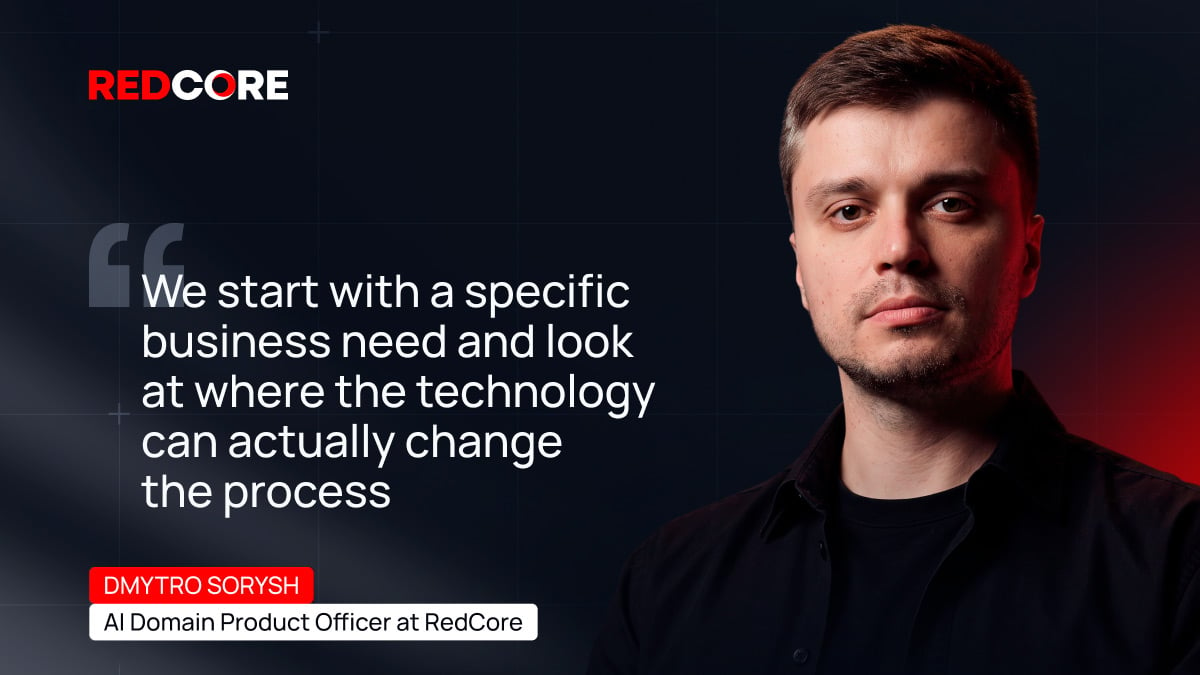
There is a lot of talk about AI in the industry, but it often remains at the level of slogans. At RedCore, we approach it differently: we don’t add AI where it simply sounds impressive. Instead, we start with a specific business need and look at where the technology can actually change the process.
Today, AI at RedCore is used in several key areas: customer support, retention, content production, and analytics.
Customer Support. All inquiries to the support department are initially handled by a bot. This reduces the customer’s waiting time for a response: there is no need to wait in a queue for an operator. The bot fully resolves more than half of the chats independently, without human involvement. This frees operators from routine requests, allowing them to focus on complex cases where expertise and a human approach are important.
Quality Control. We have automated part of the quality control process. Instead of selective manual checks, the system works faster and more consistently at scale. This makes the QC process faster and higher quality.
Content. Content assistants and translators reduce the time and costs of content production while maintaining the quality of the result.
Infrastructure. Because the bot handles a significant portion of the incoming support volume, the load on the ticketing system is reduced, along with the costs of maintaining it.
Fraud & Risk. Artificial intelligence and ML models are a key element of our fraud prevention system. In Frogo, the AI module analyzes users’ behavioral patterns and helps identify non-obvious fraud schemes, while the platform recalculates the “norm” in real time, significantly reducing the number of false positives and the workload on operational teams. As a result, more than 98% of decisions at the withdrawal stage are made automatically.
In addition to real-time transaction monitoring, we actively apply AI and machine learning at all stages of risk management. We use ML algorithms to automatically verify the correctness and logic of rule descriptions in scoring policies, which makes it possible to eliminate errors and conflicts between conditions before they reach production. For Big Data analysis, AI helps identify hidden insights in large datasets, enabling analysts to describe patterns of dangerous customer behavior more effectively. Finally, AI is integrated into internal processes for rapid retrospective analysis of the effectiveness and performance of the existing scoring system, allowing us to continuously optimize risk policies based on historical performance indicators.
For RedCore, is AI a way to analyze information or a tool capable of making decisions and taking actions autonomously? What does this look like in practice?
A good way to answer this question is to compare two different scenarios where AI is involved.
The first is an outbound voice agent, for example, in retention tasks. Here, AI acts autonomously: it initiates a call to the relevant customer segment, conducts the conversation according to a script, and takes it through to a result, whether that is a personalized offer or collecting feedback. A human is not involved in the call itself; their role is to define the logic and segmentation in advance.
The second scenario is an incoming support chat with a non-standard complaint, where there is an emotional context and several possible solutions need to be weighed. Here, the role of AI is different: it can analyze the customer’s history of interactions and highlight the relevant context for the operator, but the decision on how to proceed is made by a human.
This is exactly our approach: AI is neither universally autonomous nor universally supportive; it switches between two roles depending on how predictable the task is. Where the rules are clear and repeatability is high, such as in outbound voice campaigns, handling standard chats, or the basic part of QC, we allow the system to act independently. Where interpretation, judgment, or a creative decision is required, such as in complex escalations or the final editing of content, AI becomes a tool for analysis rather than an executor.
We do not choose between “autonomous AI” and “AI as an assistant” once and for all; we determine the appropriate level of autonomy for each specific task.
How do you measure the effectiveness of AI solutions? What metrics show that AI is actually working rather than simply making processes more complicated?
A revealing test for us is simple: if we turned the solution off tomorrow, would the customer notice, and would it affect the business? If the answer to both questions is “yes,” the solution is working. If “no,” it is most likely technology for technology’s sake.
From this perspective, we look at four things.
We calculate return on investment not at a single point in time, but over the long term: does the solution pay back the cost of its development through sustainable savings, rather than a one-time novelty effect? For example, the reduction in the workload on operators and the ticketing system should remain for months, not just during the first week after launch.
Support costs often turn out to be a more honest metric than launch costs. A solution that constantly requires expensive improvements eats up all the benefits of automation, even if it was inexpensive to launch.
We assess the customer experience through a simple question: does the customer resolve the issue on the first contact, or does the number of repeat contacts and escalations increase? Response speed that does not solve the customer’s problem is not an improvement, but an illusion of improvement.
The operational impact is the share of processes that have actually moved to autonomous execution, and whether this frees up the team’s time for more complex tasks rather than simply shifting the workload somewhere else.
We deliberately do not chase one-off percentage metrics. For us, the best sign is that the team continues to use the solution months after launch without even thinking about it, because it has become part of the process rather than an experiment.
Many companies face barriers when implementing AI, from technical to cultural. What are the main challenges RedCore faces, and how do you overcome them?
Technical and cultural barriers are almost equally important for us, and the worst mistake is to solve only one of them while believing the other will resolve itself.
The technical barrier usually becomes apparent not at the idea stage, but at the stage of real-world volume: a model that worked perfectly on test data starts making mistakes when it encounters the real diversity of requests, integrations, and live infrastructure. That is why we never launch a solution across the entire flow right away. First, it operates within a narrow scope, where errors are easy to identify and fix, and only after its stability has been confirmed do we scale it further.
The cultural barrier is more interesting because it rarely manifests as open resistance. Take the content team: specialists who have spent years refining the brand’s tone and communication style do not openly reject AI; they simply do not trust the draft. It is not about fear of losing their jobs, but rather the doubt that a machine will pick up on a nuance that a person intuitively senses. We do not solve this with a directive saying, “Now we use AI.” Instead, we integrate the tool where it removes the most tedious part of the work, such as drafting or routine translation, while leaving the final say to the author. In this case, trust is not explained; it is built through practice.
The worst-case scenario is when these two barriers work together: a weak technical result at the start immediately confirms the team’s cultural doubts, and vice versa. That is why we move slowly and in tandem, proving technical reliability while simultaneously giving the team time to see it for themselves on their own experience, rather than through a presentation.
Many people are concerned that AI will replace humans. How do you see the balance between automation and human expertise?
A simple rule we have developed for ourselves is: AI takes care of the volume, while humans retain the meaning.
In support, this looks like this: the bot handles the flow of routine questions, but as soon as the dialogue goes beyond the script, for example, the customer is upset or the situation is unusual, the conversation is handed over to a human. In this case, the operator is not competing with the bot for call volume; instead, they receive a more concentrated flow of complex cases where their expertise is genuinely needed.
The logic is similar in content, but in the opposite direction: AI writes the first draft, while the decision about the final tone, the key messaging, and whether the content should be published at all remains with the author. We could automate this part as well, but we consciously choose not to, because this is exactly where the value that the client pays for is created.
If we put it into one thought: we do not strive for maximum automation for the sake of automation itself. Where the quality of a decision depends on human judgment, we consciously leave that part to people, even when technically we could go further. For us, AI is not a replacement for people, but a way to remove routine from their work and give them back time for what truly requires expertise.
If you look ahead, how do you think the role of AI in digital businesses will change? What new opportunities will open up?
Looking 2–3 years ahead, I see movement in several directions.
AI will stop being a separate feature and become the operating system of the business. Today, the typical use of AI in iGaming is selective: translating text, generating a banner, answering a support ticket. In 2–3 years, it will be a full-fledged agent that manages a process from start to finish, for example, not “analyze player behavior,” but “manage the entire retention cycle for a risk segment: from detection to a personalized offer to a report on the result.” The difference is fundamental: not speeding up individual tasks, but delegating entire roles.
A new layer will emerge: “AI-as-a-service” specifically for iGaming. Good models are expensive to build (they require data on millions of players, domain expertise, and legal nuances across different geographies) and cheap to scale. This is the classic economics of B2B infrastructure. The growth of specialized vendors that sell operators ready-made AI modules is expected: recommendation systems, churn detection, personalized offer generation, AI support agents, similar to how KYC providers and payment aggregators are developed today. Small and medium-sized operators simply will not be able to afford building this in-house, which means they will become customers of such B2B vendors rather than competitors.
The barrier to entry into entire categories of business will collapse. What previously required a team of 10–15 people (marketing, analytics, support, basic development) will soon be possible for 1–2 people with properly configured agents. The new opportunity is an explosive growth in micro-businesses and niche products that were previously unprofitable because of fixed team costs. The downside is that competition will become instantaneous: as soon as someone finds a viable niche, others will be able to copy it in weeks rather than months.
Value is shifting from “producing” to “deciding what to do in general.” If content production, coding, and basic analytics become cheap and fast, the bottleneck will no longer be execution, but choosing the direction: what problem to solve, for whom, and why. Strategic thinking and preference (in product, brand, and prioritization) will become more valuable because these are things AI cannot yet replace.