








On 2 April 2025, US President Donald Trump upended global financial markets by unveiling sweeping changes to the country’s tariff policies, an announcement now known as “Liberation Day”. A year later, gaming industry suppliers are still feeling the effects of the on-again, off-again tariffs and related issues as they try to stay afloat and plan ahead.
The original Liberation Day announcements, which affected dozens of trade partners, drove the average effective US tariff rate to 22.5%, the highest since 1909, per the Council on Foreign Relations think tank.
But a week later, Trump backtracked and delayed the tariffs’ implementation for 90 days to negotiate new deals. This began a series of several proclamations and retractions over the last year that Wall Street has coined the “TACO Trade”, short for “Trump Always Chickens Out”.
Then in February, the pendulum swung back again when the US Supreme Court struck down the majority of the tariffs as unconstitutional. The court determined the International Emergency Economic Powers Act, under which the tariffs were enacted, did not give the president discretion to make such a decision. The ripple effects from the ruling could take months to parse, if not longer.
In the meantime, gaming suppliers have faced a steep task of adjusting on the fly. Daron Dorsey, CEO of the Association of Gaming Equipment Manufacturers (AGEM), told iGB in October that “no one is making long-term strategic decisions” amid such uncertainty. Things have since improved, Dorsey said this week, but not “meaningfully” so.
“Instead of saying, ‘We’ve been doing it this way for 10 years, let’s keep doing it’, everybody’s trying to be a little bit more efficient and a little bit more dynamic, realising they’re going to encounter some uncertainty or some changes or some disruptions,” Dorsey said.
Companies unsure about refunds
The biggest question for manufacturers in the aftermath of the SCOTUS ruling relates to refunds. According to The Budget Lab at Yale University, the repealed IEEPA tariffs generated approximately $165 billion, with a refund system being the assumed conclusion. However, there is little guidance or clarity on how that may be resolved.
KPMG’s Tariff Survey 3.0, released in March, showed that 62% of respondents across all industries “expect” refunds. Yet, only 28% indicated plans to “actively pursue” them, with 25% undecided and 9% not planning to pursue them. Of those who were undecided or not planning to pursue refunds, over a third (37%) indicated that “legal costs might outweigh the potential refund”, per KPMG.
During this time, AGEM has “tried to be an information resource for its members”, Dorsey said. While suppliers are competitors among themselves, they share common goals when compared to the overall market.
“Every company is a little bit different and is going to go about it a little bit differently, but we’re saying, ‘Here’s some information that applies to all, if you need to get with your folks or your professionals or your teams, here’s some information you might find helpful’, and that’s at least a dialogue where people can know that they’re not alone,” Dorsey said. “Everybody is going through this in their own particular way, so there’s some comfort and some understanding that people can communicate and collaborate.”
Market outlook impacted by tariffs?
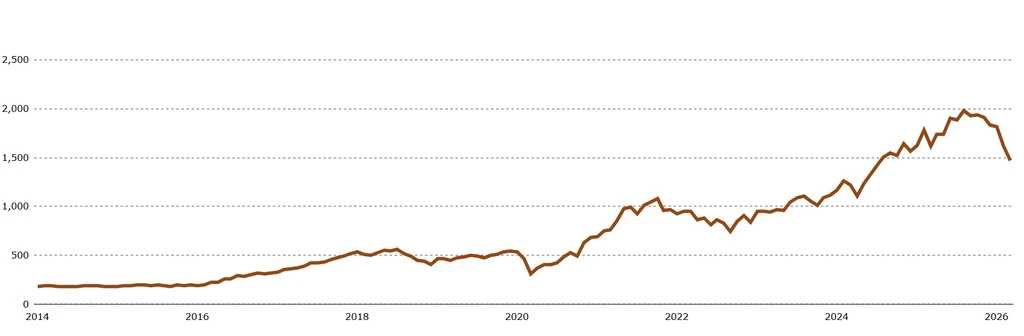
AGEM publishes a monthly stock report, called the AGEM Index, which tracks the share performances of nine association members trading on exchanges in the US, Australia and Japan.
Its most recent reading for March was 1,472, a decrease of 9% from March 2025, the last month prior to Liberation Day. Notably, beginning in April last year, the Index grew steadily to a high of 1,983 last August, but has been declining since. Comparatively, the S&P 500 has gained 16% since last March, the Dow Jones Industrial Average has gained 10% and the Nasdaq Composite has jumped 23%.
The declines are mostly confined to the first quarter of 2026 when the Index fell more than 300 points. After a 10.7% monthly decline in February, the Index slid another 9.2% in March. The S&P 500 also slumped in March before rebounding somewhat early this month.
While the Index is still well ahead of its debut of 183 in January 2014, it seems notable that the Covid-19 pandemic, another manufacturing disruptor this decade, did not seem to have the same impact stock-wise. At the height of panic in March 2020, the Index sat at 312, but it has never dipped below that total since.
Slump among suppliers
The three biggest industry suppliers – Aristocrat, Light & Wonder and IGT – have seen varying results since last April. Aristocrat shares are down 19% in that span, while L&W is flat and IGT is now privately held by Apollo Global Management. IGT, which was merged with Everi Holdings under Apollo, announced layoffs last month that impacted about 10% of its workforce.
All three companies declined to comment for this story.
Immediate effects from tariffs were largely offset in 2025, but the largest companies will likely see some level of impact moving forward, an industry source told iGB on condition of anonymity. That said, hesitancy from buyers could dissuade suppliers from making big changes, at least for now.
“From our conversations with slot purchasers (and reported numbers), there hasn’t been a material change in price, given suppliers are weary of softening demand; suppliers are likely absorbing any cost increases in the supply chain,” the source said.
Suppliers part of broader industry uncertainty
On that point, Dorsey noted that as B2B companies, any outlook on suppliers must consider their customer bases as well. The casino industry has largely been steady in recent years after a record post-Covid surge in performance from 2021-2024, but its revenue growth has not matched sports betting or iGaming.
US casino revenue grew 2% YoY in 2025, per the American Gaming Association, compared to 22% for sports betting and 27% for iGaming. However, sports betting and iGaming expansion efforts have largely stalled, with just one sports betting market (Missouri) and one iGaming market (Maine) legalising since the start of 2024.
The rise of prediction markets, which the industry views as unlicensed gambling, has in turn affected all three regulated sectors and added an extra layer of tepidity. Prediction markets’ foray into sports event contracts has siphoned more than $730 million in would-be state taxes, per a tracker published by the AGA. Operators Kalshi and Polymarket have seen their valuations soar to around $20 billion; that already matches Aristocrat’s current market capitalisation, the highest among its peers.
“Our suppliers supply operators and regulated gaming environments around the world, and however they feel about their businesses, we have to match and mirror those and respond to them,” Dorsey said. “If they’re in a place where they feel uncertain, they may make buying decisions based on that, and that’s outside of our control as suppliers, but we have to be cognisant of that and responsive to that.”
Other topics of note
Dorsey said in October that suppliers were exploring their options for tax incentives under Trump’s omnibus “One Big, Beautiful Bill” from last July. Those conversations, he said this week, have not carried over much.
“I would say that’s maybe nebulous, there’s some of those benefits that are sort of baked in because people have closed the financial year,” Dorsey said.
Instead, Dorsey said the sector is more closely focused on the US-Mexico-Canada Agreement (USMCA), which comes up for review in July. The trade agreement was brokered by Trump in 2018 and took effect in 2020. This year’s review was originally considered routine, but the litany of events since its introduction, including Trump’s rebukes of Canadian and Mexican leaders, could colour the conversations.
According to the Center for Strategic and International Studies think tank, the USMCA “could enter a period of annual reviews if renewal is delayed or denied”, and “one or more countries could withdraw, opening the door to a return to bilateral arrangements or expiration” in 2036.
“Some of these component parts in how trade stitches together and what it costs and how you move things across borders and how you put things within subsidiaries within your corporate global framework, those are still ongoing,” Dorsey said.
Rising tariffs and subsequent business decisions could have regulatory impacts for suppliers, Dorsey said. There are necessary parts and materials that are difficult to source, he said, and changes can’t be made hastily.
“We’re highly regulated by very specific product standards that include all the component parts,” Dorsey said. “I don’t have a way to switch A to B without saying, ‘Do I need to go get certificates for all of my different hardware, all my different software, across the board by hundreds of jurisdictions and hundreds of products?’”

Jess Marquez
Jess has covered the global gaming industry since 2022. A native of Reno, Nevada, he’d like to note that it’s Ne-va-da, not Ne-VAH-da.
Original article: https://igamingbusiness.com/casino-games/product-technology/suppliers-tariffs-one-year-later/