








Ever since US President Donald Trump began his second term last January, the Federal Reserve has been at the centre of much controversy and consternation. Outgoing Chair Jerome Powell continues to spar with Trump over the president’s desire to quickly lower interest rates in the face of growing macroeconomic uncertainty.
The Fed does not directly oversee or regulate prediction markets – that role is given to the US Commodity Futures Trading Commission. There are indications, however, that a group of economists from the central bank are using event contracts as a predictive research tool to gauge various economic expectations, most notably interest rates and inflation. A Fed study published last month suggested as much, finding that “Kalshi markets provide a high-frequency, continuously updated, distributionally rich benchmark” that is valuable to both researchers and policymakers.
While Powell’s term as chair is set to end in mid-May, a stand-off has ensued in Washington on the timing of his departure. A confirmation hearing for Trump’s nominee, Kevin Warsh, still has not been scheduled. One prominent member of the Senate Banking Committee, Senator Thom Tillis (R-NC) may threaten to delay the proceedings, with Powell determined to remain as chair until Warsh is confirmed. The ambiguity over the timing could inject further uncertainty on the Fed’s position regarding prediction markets before the November mid-term elections.
Findings from the study
The 40-page study, titled “Kalshi and the Rise of Macro Markets”, is co-authored by Anthony Diercks, principal economist of the Board of Governors for the Federal Reserve System. Diercks, who also serves as an economist for the Fed’s Monetary and Financial Market Analysis Section, was joined by two other researchers.
Jared Dean Katz, a PhD student in financial economics at Northwestern, previously served as a research assistant at the Federal Reserve under Diercks. The third author, Jonathan Wright, is a research associate at Johns Hopkins University’s economics department.
Their research into the inner workings of macroeconomic policy is technical and complex, but their interest in prediction market data as a new tool for research is clear. The authors focused solely on Kalshi data for the report because, in their words, “Kalshi represents the most mature and comprehensive prediction market for economic forecasting”.
Kalshi has been the poster child for prediction market backlash in the US. The company helped spark the sector’s growth during the 2024 elections by winning a legal battle with the CFTC to offer political contracts. Since then, the exchange platform has been sued in multiple state and federal courts, and most recently was hit with criminal charges by the state of Arizona.
Predicting inflation, rate cuts
The biggest theme of the paper is that data gleaned from Kalshi markets are superior to existing tools like polls and futures markets. Further, Kalshi’s markets give insight to metrics that were previously difficult to contextualise, such as unemployment, gross domestic product and more. Existing research tools don’t move quick enough for our ever-changing world, authors said, while prediction markets offer continuous, real-time feedback.
“Using newly available contracts across a broad set of macroeconomic indicators, we have shown that Kalshi-implied distributions are well-behaved, responsive to news and comparable in forecasting accuracy to established benchmarks such as the Survey of Market Expectations and the Bloomberg consensus,” authors wrote.
“In several cases, they provide unique insights – particularly for variables like GDP growth, core inflation, unemployment and payrolls, for which no other market-based distributions currently exist.”
In at least one instance, Kalshi did a better job of forecasting the correct interest rate cut imposed by the Fed in comparison with traditional measures, according to the authors. While various forecasting models established probabilities for a 25-basis point and 50-basis point cut, Kalshi put greater weight on the latter. The Kalshi prediction turned out to be correct, the authors wrote.
Outsized trading volume on sports
Ironically, the backlash against prediction markets relates almost solely to sports contracts, which opponents claim is illegal gambling veiled as financial investment. The economists only mentioned sports event contracts once in the entire research paper.
Prediction platforms are having a hard time arguing that sports events constitute genuine economic hedging vehicles, but none would dispute that logic for markets like Fed decisions, which do have wide-ranging economic impacts, particularly for large corporations and institutional investors. Based on the Fed research, this could become the one of most useful purposes for prediction market data moving forward.
“Prediction markets offer high-frequency, continuously updating forecasts that can complement central bank decision-making,” the report said. “High-frequency data let us apply an event study methodology to see how news shapes beliefs about macroeconomic indicators.”
“For macroeconomic indicators like CPI and unemployment – two pillars of the Federal Reserve’s dual mandate – market-based forecasts improve the Fed’s ability to communicate policy direction and assess the market’s perceived reaction function under various scenarios.”
Soaring valuations
One problem, however, is that prediction markets’ meteoric rise would not be possible without the eye-popping sums wagered on sports. Without the influx of retail traders who care mostly about sports and pop culture, the platforms would still exist but would likely be relegated to niche products within the financial community.
Kalshi’s valuation as of December was $11 billion, one that is higher than many legacy gaming companies. More recent reports this month suggest that both Kalshi and Polymarket sought new investment rounds that would value each company at north of $20 billion. According to a Bloomberg report on Thursday, Kalshi raised more than $1 billion in a new funding round that valued the company at $22 billion.
Still, periodic reviews of trading show that sports contracts now constitute more than 80% of the platform’s business. In one example from Thursday afternoon, more than $24 million had been wagered on the Duke University – Siena University first-round NCAA tournament game, compared to $2.7 million on the next Fed decision.
Potential liquidity issues
Should prediction markets like Kalshi lose their sports products, trading volume could plummet, which in turn could impact liquidity and the usefulness of the economic research. Most of the complex financial derivatives don’t attract much volume and as the report states, “the retail investor base of Kalshi might alter the risk premia properties”.
“Separately, the outermost (tail) contracts often suffer from low trading volume, which can lead to tail prices and noisy estimates in the tails of the distribution – especially in illiquid markets,” the authors continued.
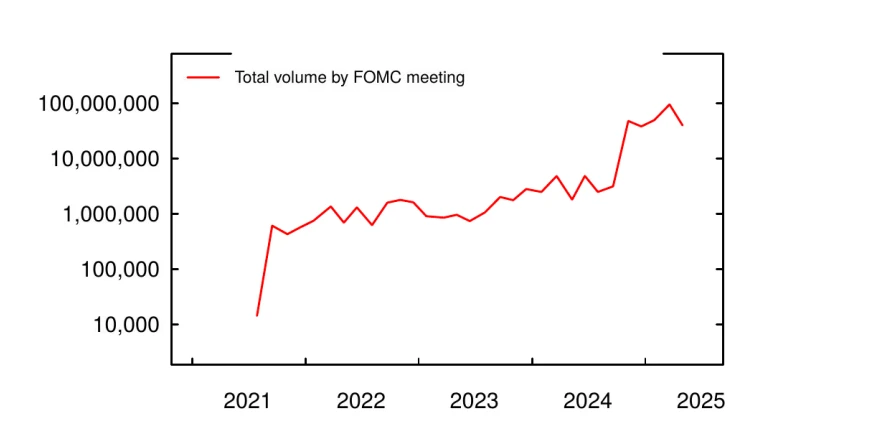
But these issues “are not unique to Kalshi”, the report says, as traditional options “also suffer from sparse trading in extreme outcomes” while others “over the past several years have not traded at all”. If anything, the report shows that trading volume on Kalshi’s Fed contracts has steadily increased over the last five years, as shown by the below graph.
Researchers asserted that as the markets “mature and liquidity deepens, their potential to enhance real-time policy analysis and academic research will only grow over time”.
Fed holds rates steady amid Middle East conflicts
Meanwhile, the Fed itself opted to hold rates steady at 3.5%-3.75% this week, with Powell citing uncertainty related to the widening Middle East conflicts. There is reason to believe the gaming industry would benefit from a series of rate cuts, but that optimism could be fading – on Kalshi, the odds of the Fed maintaining rates again in April sit above 90%.
The Fed ended 2025 with three consecutive cuts but has held rates steady in all three months this year. The Federal Open Market Committee is scheduled to meet next on 28-29 April.
The situation involving Powell’s transition is also growing increasingly murky. Trump’s Justice Department subpoenaed Powell in January over testimony related to renovation costs at the Fed headquarters, which the latter dismissed as “pretexts” for failing to comply with Trump’s agenda. Those subpoenas were ultimately squashed earlier this month by a DC federal court.
“A mountain of evidence suggests that the Government served these subpoenas on the Board to pressure its Chair into voting for lower interest rates or resigning,” Judge James Boasberg wrote in the court filing.
Powell transition unknown as investigation plays out
This investigation has stalled the nomination process for Warsh, and Senate Banking Committee members have pledged not to move forward with any nomination until the matter is fully resolved. This has inspired questions as to whether Powell would remain as chair if his term ends without a successor, or whether he will leave his governor role, which has typically been the case with outgoing chairs.
Tillis, an outgoing Senator who is not seeking re-election, met with Warsh this week. Although Tillis said that Warsh “possesses impeccable credentials”, the Senator stopped short of asserting that he will advance the nomination. As of Thursday, Powell had an implied probability of 43.6% on Kalshi to leave his position as Fed governor by 1 June. The odds, which are the lowest in at least a month, have fallen sharply from a probability of 75% on 21 February.
Powell, meanwhile, said at this week’s Fed press conference that he plans to continue serving as chair pro tem if his successor is not confirmed when his term as chair expires.
“That is what the law calls for, that’s what we’ve done on several occasions, including involving me, and that’s what we’re going to do in this situation,” Powell said.
“And while I’m at it, on the question whether I will leave while the investigation is ongoing, I have no intention of leaving the Board until the investigation is well and truly over, with transparency and finality…On the question of whether I will then continue to serve as a governor after my term ends, and after the investigation is over, I have not made that decision yet. And I will make that decision based on what I think is best for the institution and for the people we serve,” he added.

Jess Marquez
Jess has covered the global gaming industry since 2022. A native of Reno, Nevada, he’d like to note that it’s Ne-va-da, not Ne-VAH-da.
Original article: https://igamingbusiness.com/finance/federal-reserve-prediction-markets-paper-warsh/