








Prediction markets are overhyped, and underperforming. Quite a bold statement, given all the headlines of billions of dollars of monthly volume, strong growth rates and eye-watering valuation. So, is this an unfounded contrarian view, or a fair analysis based on the underlying data?
The latest implied valuations of the two main prediction markets – Kalshi ($22 billion) and Polymarket ($20 billion) – are both materially ahead of the two main sports wagering operators Flutter [FanDuel] ($18 billion) and DraftKings ($11 billion) in the US.
Given that Flutter is a multi-national business, the best comparison is DraftKings – with these ‘valuations’ suggesting that Kalshi and Polymarket are worth double what a leading sportsbook is worth in the US – despite the clear regulatory risk of the prediction market business model (based on the number of ongoing lawsuits – not an H2 analysis of the regulatory/legal system in the US).
Recent headlines on prediction market volumes also strongly convey the message that prediction markets are overtaking (have overtaken?) legal sports wagering operators in the US. But beyond the headlines, analysis of the data tells a different story. Below H2 analyses the data behind two of the most recent sports events that have accelerated the prediction market hype.
‘2026 Super Bowl: Prediction market volume of $1.6bn overtakes sportsbook handle of $1.4bn‘
Quite a headline – and in some ways entirely true. Based on reported prediction market volume, activity was higher than H2’s revised estimate of sportsbook handle of $1.4 billion for the Super Bowl. However, this comparison is nonsensical. It’s akin to measuring apples by the kilo and oranges by the dozen. Both of these are units of measurement, but completely incomparable without some form of metric equalisation.
So how does prediction market volume compare to sportsbook handle? We have seen a number of industry commentators estimate the relationship, but it varies considerably across sports. The best analysis that we’ve seen is in an article by David Huffman, chief operating officer of Sporttrade, which is a state regulated betting exchange (prediction market).
Being a regulated wagering operator at a state level, the company has to report handle, but also measures trading volume internally – and is therefore (almost uniquely) placed to offer the relationship between volume and handle across different sports. The conclusion of this is as follows:
- Golf and futures markets – Handle is equivalent to 5%-20% of volume
- Game markets (basketball/football/baseball) – Handle is equivalent to 45%-55% of volume
Therefore, based on the Sporttrade internal data, it implies that prediction markets generated c.$800 million of ‘handle equivalent’ on the Super Bowl, compared to $1.4 billion generated by legal sportsbooks. A different picture to the headline, but not materially.
After all, prediction markets are relatively new and scaling quickly, compared to sportsbooks. On that basis, prediction markets are performing strongly – even comparing handle to ‘handle equivalent’. But is that the whole story?
Being 90% right can still mean being 100% wrong. Therefore, to really understand how prediction markets are performing, it’s only fair to do further analysis to understand how they really did in a head-to-head with legal sportsbooks.
2026 Super Bowl – Prediction market vs sportsbooks head-to-head comparison
The question shouldn’t be: “How much volume did prediction markets do on the Super Bowl?”
The question should be: “How did prediction markets perform against sportbooks in a head-to-head comparison?”
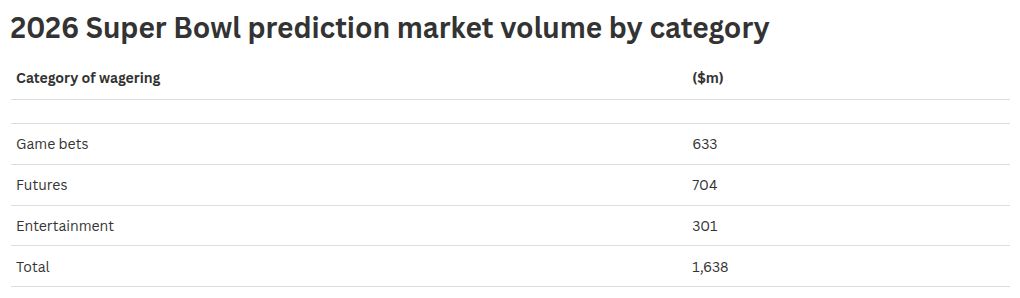
Reporting on the exact volumes relating to the Super Bowl for prediction markets is messy at best, with many conflicting and confused reports – with media reports confusing Super Bowl volumes for daily volumes, and wagering on the actual game versus wagering on entertainment (which sportsbooks cannot do – and therefore can’t be compared in a fair head to head comparison) and futures bets (i.e. bets during the season on the season long winner – not bets on the Super Bowl game itself, which is what H2’s handle is based on).
$633 million of prediction market volume for Super Bowl LX
Based on reported data across numerous media outlets, interviews and prediction market tracking services, H2 estimates that on a like for like basis, prediction markets generated $633m of betting volume on the Super Bowl itself. This encompasses both the match result, as well as prop bets / MVP bets – effectively, everything that legal sportsbooks can offer.
The large futures figure is predominantly from Polymarket, which is volume of activity on the season champion made throughout the season, rather than wagering on the Super Bowl match itself. The entertainment figure is predominantly Kalshi, who took over $100 million of wagering volume on what “Bad Bunny’s first song” would be in the half-time show.
Therefore, on a like for like comparison, the Super Bowl wagering on prediction markets was an estimated $633 million of volume, or based on the c.50% handle/volume relationship, $317 million of handle equivalent – compared to H2’s estimate of $1.412 billion for licensed US sportsbooks.
This means that on a like for like basis, only 18% of handle was generated by prediction markets.

Structural advantage of prediction markets
This gets us closer to the answer, but does still not fully answer the question of how prediction markets compared to sportsbooks on a head-to-head basis – which is the question that we need to answer, to understand how much of a threat prediction markets are to legal sportsbooks.
Prediction markets are able to operate across the whole of the US, yet sports betting is not legal in states that represent 35% of the US (by both adult population and GDP). Yes, that is a structural advantage of prediction markets (at the moment), as is being able to offer wagering on entertainment markets – but Kalshi generating revenues from a market where sportsbooks can’t operate is not taking away sportsbook revenues.
While there are no published metrics on this, it follows that prediction markets will generate disproportionately higher revenues in states where there is no legal sports wagering than in those where there is competition with sportsbooks. The scale of this difference is unknown, but given the strong presence of sportsbooks in states where they are able to operate, H2 conservatively believes that in states where there is no competition, prediction markets are likely to be making between two and five times more revenue than in those where there is competition.
Assuming a 3.5x mid-point, this implies that prediction markets will make c.65% of revenues in states where there is no legal sports wagering, or c.35% of revenues will come from states where they are in direct competition with sportsbooks. This leads to an equivalent handle of $110 million in those states where legal sportsbooks are present.

This equates to $100 million of handle equivalent wagered on the actual Super Bowl game in states where there is legal sports wagering, or a 7% share for prediction markets and 93% share for legal sportsbooks.

This is almost a fair head-to-head comparison, but not quite. In those states, prediction market operators can provide their product to anyone over the age of 18, compared to 21 for sportsbooks. In the US, c.5% of the adult population (18+) are aged between 18 and 20 – and prediction market operators have no competition for these customers from legal sportsbooks.
Self excluded players can turn to prediction markets
On top of this, H2 estimates that c.1% of online sportsbook customers are self-excluded (based on data from New Jersey and Pennsylvania’s self-exclusion programmes). Therefore, while prediction markets may be generating c.7% of the handle equivalent in markets where they compete with sportsbooks, they also have access to c.6% of the market that legal sportsbooks are unable to access.
When then looking at this on a revenue basis, the differential is even greater. While the hold margin can vary in any individual event, using an average online sportsbook hold margin of 10%, over time, the Super Bowl should generate an ‘average’ GGR (or operator revenue before accounting for player bonuses) of $141 million.
However, the average revenue for sports wagering for prediction markets is reported to be c.1.1% of volume – which for the comparable market / state volume of $220 million (35% of Super Bowl Game Market Volume of $633 million) equates to revenues of just $2.4 million – or just 2% of the market.
Even if you were to take the whole $1.63 billion of volume that was generated by prediction markets across all products of the Super Bowl (including almost half of this being on futures – which would be additional handle for the sportsbooks not included in this analysis) – a 1.1% volume to revenue figure equates to just $18 million of revenues – compared to licensed sportsbooks at over $140 million of GGR on an ‘average’ hold margin (the hold margin was substantially higher for the Super Bowl this year).
The same dynamic played out again with the Masters, where the following headline takeaway was provided as “further evidence” of the phenomenal growth and dominance of prediction markets in the US.
Masters the most-bet single sports event in the platform’s history
However, the same analysis as for the Super Bowl shows the same underlying trend – high volume figures, but uninspiring performance at a handle level when put head-to-head with sportsbooks – although given the nature of the tournament and the increased trading, this led to a slightly improved performance at the revenue level.
Sporttrade’s analysis shows that handle for golf is only 5%-20% of volume, given the trading in and out of positions that happens. While this trading makes it an ideal product for prediction markets, given them a structural advantage over sportsbooks in one respect, the underlying performance is still relatively poor, in H2’s view.
H2 has taken Kalshi’s reported activity on the masters, added on an estimate for Polymarket based on prediction market tracking data, and grossed it up to take into account other prediction market operators to get an estimated $700 million of masters wagering volume.
Taking the midpoint of 5%-20% (12.5%) and the same estimate of 3.5x more activity in states with no legal sports wagering, this implies handle equivalent of just $30 million in states where there is legal sportsbetting.

Based on data from a number of states that split out golf as a separate product, and under the assumption that the Masters accounted for 65% of April’s golf handle last year, this implies that in 2025 the Masters generated $230 million of handle for legal sportsbooks. Assuming no growth year on year, this would imply that 88% of handle was generated by legal sportsbooks, with 12% generated by prediction markets in states with legal sportsbooks.

Golf represents prediction markets at their best
While this is an improvement on the Super Bowl handle picture, context matters. Golf is structurally the most favourable product for prediction markets — the multi-day format encourages repeated trading in and out of positions, inflating volume figures far beyond what a sportsbook would record as handle.
Put simply, products such as golf represent prediction markets at their relative best, as demonstrated by the Sporttrade relationship between volume and handle. Despite this, and the fact that prediction markets still have access to c.6% of the population in these states that sportsbooks cannot cater to (18-20-yr-olds and those self-excluded), on a like-for-like handle basis in states with legal sports wagering, sportsbooks still hold an 88% share of ‘handle’.
However, the increased trading volume does benefit GGR for the prediction market operators, given the fees charged per trade. Therefore, on a GGR basis, the performance is closer, with prediction markets generating c.$2.7 million/10% of the market, due to the higher amounts of trading leading to higher prediction market fees.


Prediction markets (betting exchanges) have always had a structural advantage in certain markets, but a disadvantage in other ways. For example, in the UK, Betfair had a significant share of the horse race wagering market as it was the only market where you could lay a horse, and trade your position.
But the share of horse wagering did not translate to other betting markets. The same can be said of the Masters and prediction markets, where we believe the underlying performance of the Super Bowl is more representative of the overall positioning of prediction markets than that of the Masters.
The high volume of trading on competitions such as this is highlighted by the reported transaction volume. Kalshi is reported to have processed 97 million transactions in 2025, and 18 million transactions during Super Bowl week in 2026 (when the company had deposit issues due to the trading volume on Super Bowl Sunday). This increased to a record 22 million transactions in the Masters week in April 2026 (due to it being a four-day event rather than a single match).
By comparison, Betfair (one of the original prediction markets) at its peak was processing over 120 million transactions a day….

Disclaimer
* There is no published data on the amount of activity in terms of volume, handle or revenue that prediction markets have achieved in head to head competition with state regulated sportsbooks. All of the figures in this report are H2 estimates; all of the workings and datapoints for the calculations have been clearly set out, so that readers are able to adjust the key variables to stress test the analysis and come to their own conclusions.
Conclusion
While the headline metrics all paint a very positive picture of the prediction market industry, H2’s analysis shows a very different picture:
- On a standalone basis, prediction markets are producing strong volume figures – but it is a misleading figure that is designed to generate headlines rather than show the true performance of the industry. Volume is incomparable to sportsbook operator handle; depending on the product, the equivalent handle can be as low as just 5% (golf) or up to 50% (single game football) of volume.
- Looking at prediction markets on a standalone basis, it is fair to look at all products (including ones not being able to be offered by sportsbooks) in all states (including those without legal sports wagering)? However, even then, volume is the wrong metric. If volumes are driven by market makers rather than true peer to peer wagering, fees (revenues) are lower – and therefore volume is a misleading metric compared to revenues.
- However, when considering whether prediction markets are a threat to legal sportsbooks, the analysis should be conducted on a head-to-head basis, to see what revenues they are ‘taking away’ from sportsbooks. On this basis, the metric has to be comparable, like for like handle equivalent, based on sportsbook products in the states in which they operate.
- When compared to the legal sportsbooks, prediction markets appear to be significantly overhyped and hugely underperforming. H2 estimates that on a like for like, head-to-head basis, prediction markets generated just 7% of market handle in states where it was competing with sportsbooks on the 2026 Super Bowl, despite having access to 6% of the population that sportsbooks aren’t able to serve.
- Therefore, based on the current available data, H2 believes that prediction markets are only able to thrive in a regulatory vacuum where there is no legal competition to their product. While they have some inherent advantages over traditional sportsbooks (trading in and out of positions), they also have inherent disadvantages – which is the reason why Betfair launched a sportsbook in 2012, alongside their exchange product.
- Prediction markets are not new, and not innovative as a product. As a platform / product, betting exchanges have been around for decades, while ‘prediction markets’ have just overlayed an improved UX for the mass market, casual customer. For those who believe that history has a way of repeating itself, the history of Betfair makes interesting reading – as, for the more historically minded, does Haarlem, 1637.

Ed Birkin is the Managing Director of H2 Gambling Capital, renowned as the foremost provider of market intelligence in the global betting and gaming industry. With a wealth of expertise spanning almost 20 years, Ed has an extensive background in both land-based and online operations across the gaming, betting, and lottery segments.
Before his tenure at H2 Gambling Capital, Ed analysed the global gambling sector for a number of top tier investment banks, starting at Dresdner Kleinwort, before moving to lead the gaming analysis for Barclays Capital’s European Equity Research division, and then as a Director in Credit Suisse’s Equity Research department, where he also led the bank’s analysis of the gaming sector.
H2 Gambling Capital has been widely regarding as the leading provider of market intelligence since its inception in 2008. Under Ed’s leadership, the company has expanded its product offering to include both company analysis as well as market analysis, aided by detailed player surveys, monthly tracking of the Brazilian market size / market share, and detailed illegal market analysis.
Original article: https://igamingbusiness.com/sports-betting/online-sports-betting/h2gc-prediction-markets-overhyped/