








Prior to this year’s Fifa World Cup only three players have ever scored ten goals at a single tournament, and none since 1970. Frenchman Kylian Mbappé became the fourth, finishing on ten and winning a second Golden Boot. The Argentinian, Lionel Messi, scored eight, while Spain ultimately lifted the trophy. The tournament expanded, but the familiar names dominated.
In wagering, recreational money clusters around familiar names and favoured outcomes. When they all land together, the liability compounds. A favourite-friendly run of NFL results in late 2024 cost FanDuel’s parent, Flutter, an estimated $438 million in gross gaming revenue.
Parlays magnify that concentration. As we covered in an earlier note, punters like multis because a small stake can become a payday. Bookmakers like them because bundling the legs into one price makes the margin difficult to observe.
Open competition
Parlays became the sportsbook’s best product by pairing recreational demand with exceptional economics. Across Illinois, New Jersey and Colorado, they accounted for around 27% of money wagered but 56% of sportsbook revenue, according to The Wall Street Journal.
Operators carry licences, taxes, compliance, promotions, market-access payments and supplier revenue shares. That cost structure favours high-margin, price-insensitive bets. Parlays are exactly that bet.
For years the product looked untouchable. Then, on 29 September 2025, Kalshi launched Combos. The next day DraftKings fell 12% and Flutter 10%, although the product had barely traded. The industry’s highest-margin product had entered a structure where independent market makers compete for every order and take the other side of customer positions.
Prediction markets have also reached customers in states such as California and Texas, two of the largest states where online sports betting remains prohibited. Whether that access survives state challenges, or sports-related prediction markets survive them at all, is contested. The demand is not.
The scale
Bank of America estimates Kalshi processed roughly $125 million per World Cup match. On a recent Sunday without a major fixture, it still turned over about $945 million in volume (Ticker Tracker). Exchange volume counts both sides of every contract at face value, so these are notional figures rather than sportsbook handle or revenue.
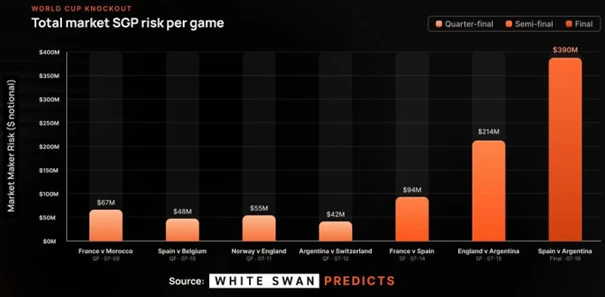
Same-game parlay (SGP) risk per match during the World Cup, on Kalshi alone. Risk here is the maximum a market maker must pay out if every leg of a combo lands. Source: White Swan Predicts
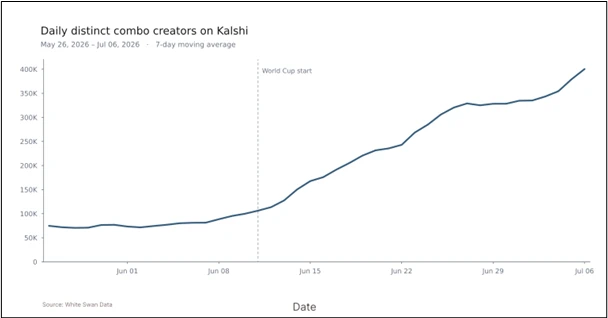
Kalshi’s daily combo creators rose from about 100,000 at the World Cup’s opening to nearly 400,000 by 6 July. (Seven-day moving average.) Source: White Swan Predicts
All roads lead to the NFL, which drove the first step-change in prediction market sports volume last season. This time, the product, liquidity and distribution are further advanced. For the opening week of the 2026 season, White Swan estimates that Kalshi alone will carry around $8 billion in maker risk.
An auction for risk
A sportsbook sets the price, manages risk across its book and decides whether to accept a bet. On an exchange, the customer builds a combo and submits a “request for quote”. Competing market makers respond with prices and the best quote wins. If accepted, the maker takes the other side and posts its maximum possible loss as collateral until settlement.
A customer might request England to win, Kane to score and over 2.5 goals. To the customer, it still feels like an accumulator. Behind the app, it is an auction for risk.
Prediction contracts now appear inside fintech, crypto and fantasy apps. That distribution reaches a vast retail audience, but every combo still needs someone to price it. The exchange supplies the distribution; the market maker supplies the balance sheet and the price.
Pricing the risk
Capital limits how much business a maker can accept. At a parlay price of 17/1 (18.0), every $1 of customer stake locks $17 of collateral until settlement. An outright can tie up that capital for weeks; a same-day combo can release it within hours. Returns therefore depend not only on pricing edge, but also on how efficiently capital turns over.
Competition is also key. Offer too short a price and the order goes elsewhere. Quote too big, and the sharp money picks you off. A sportsbook sets its own parlay margin; a maker on an exchange earns only what survives competition.
Correlation creates the modelling challenge. Outcomes within a match are linked. If France win comfortably, Mbappé is more likely to have scored and over 2.5 goals is more likely to have landed. A maker must measure how each outcome changes the probability of the others across thousands of combinations, in real time. Copying sportsbook prices is not enough because they already include the bookmaker’s margin and its commercial choices.
Market makers also tend to short the same public favourites, so a single result can settle thousands of related combinations at once. The job is not pricing each leg in isolation, but the whole distribution.
The opportunity
Financial market makers bring capital, execution infrastructure and latency management, but often lack specialist sports models. Professional betting syndicates have spent decades pricing sport, modelling correlation and managing risk across thousands of markets. Given capital, they are better placed than generic trading firms to capture value in prediction-market combos.
Waterhouse VC is working with one of the world’s leading professional betting syndicates to address the opportunity. The syndicate combines decades of experience pricing complex wagering risk with proprietary sports models and exchange-native trading infrastructure. Capital without pricing expertise gets picked off; pricing expertise without capital cannot scale.
Every quote must be fully collateralised, so more capital means more capacity to quote, and the room to deploy that pricing edge across more markets and at greater scale.
Original article: https://igamingbusiness.com/prediction-markets/the-role-of-market-makers-prediction-markets/