








Days before San Jose hosted the Sweet 16 in the NCAA tournament, a California senator co-authored legislation that seeks to ban contracts on sports, war and elections on the federal level.
The proposed bill, the Prediction Markets Are Gambling Act, aims to prohibit entities registered with the Commodity Futures Trading Commission (CFTC) from listing any event contract that resembles a sports bet or a casino-style game.
Senator Adam Schiff (D-California) seeks to amend Section 5c(c) of the Commodity Exchange Act by adding language that would prohibit sports and “casino-style” event contracts. The proposed legislation also contains an amendment that would prohibit “any agreement, contract or transaction relating to any sporting event” from preempting state law.
Schiff, a strident critic of prediction markets, introduced the legislation on 23 March along with Senator John Curtis (R-Utah).
“Rather than enforce the law, the CFTC is greenlighting these markets and even promoting their growth,” Schiff wrote in a statement. “It’s time for Congress to step in and eliminate this backdoor which violates state consumer protections, intrudes upon tribal sovereignty and offers no public revenue.”
Days later, Schiff and Curtis joined two other lawmakers in introducing the bipartisan Public Integrity in Financial Prediction Markets Act of 2026. Senators Todd Young (R-Indiana) and Elissa Slotkin (D-Michigan) also co-authored the proposed legislation.
The bill prohibits federally elected officials and government employees from using insider information to bet on prediction market contracts. Any covered individual who violates the prohibition will be fined the greater of either $500, or the amount equal to double the profit made in the transaction, according to the bill.
“Recent activity in prediction markets has raised real concerns that individuals with access to sensitive, nonpublic information could exploit that advantage for financial gain,” Young wrote in a statement.
Stocks feeling prediction pressure?
Kalshi CEO Tarek Mansour denounced the prediction market legislation in a Monday post on X.
“[The] casino lobby is hard at work. There is a reason tens of millions of people use regulated prediction markets: it’s a better product,” Mansour wrote. “Banning just pushes this offshore, where no regulation exists. This bill isn’t about protecting consumers; it’s about protecting monopolies.”
For the companies offering both sports betting and prediction products, Wall Street seemed to react negatively to the bill. On the Nasdaq, DraftKings dipped below $21 a share on Friday to fall to a fresh 12-month low at $20.53. The introduction of the legislation helped contribute to a 12% decline on the week.
Flutter, which fell by 4% on the week, sunk to a $100 share price for the first time since 2022. DraftKings and Flutter are both down more than 40% over the last 12 months. Penn Entertainment, which does not have immediate plans to launch a prediction market, closed Friday at $13.77, up fractionally on the week.
Trump: 2024 election markets more accurate than polls
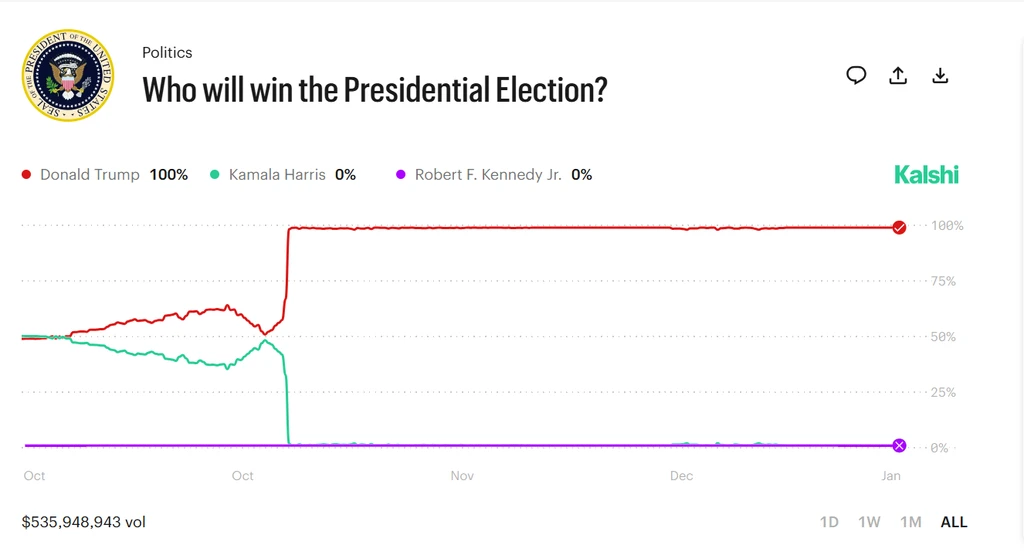
In 2024, Kalshi users recorded trading volume of $535 million on event contracts on the US presidential election. Now, 16 months after his win over Kamala Harris, Trump spoke publicly for the first time on prediction markets. In a brief interview appearing in The Washington Post, Trump called prediction markets on the election more accurate than traditional methods, which he dubbed as “fake polls”.
“They predicted me pretty right … by a landslide,” Trump said in a phone call with Max Raskin, a fellow at New York University School of Law.
In the week before the election, traders on Kalshi and Polymarket placed the odds of a Trump victory around 65%, before the margin narrowed as polls opened. Trump had a 58% chance of winning on Polymarket the night before the election, along with a 53% probability at Kalshi.
As exit polls came out on election night, Trump’s odds on Kalshi jumped to 66.9% at 5pm ET, from 57.5% 10 hours earlier. Since then, event contracts on two geopolitical matters, the removal of Venezuela President Nicolas Maduro and the killing of former Iran Supreme Leader Ali Khamenei, have garnered controversy for insider trading suspicion.
Trump did not comment on Schiff’s bills or the derivatives on the two leaders. The sitting president also did not opine on if a states rights’ case on prediction markets could reach the Supreme Court.
The president’s Truth Social reached a deal last October with Crypto.com to make prediction markets available on the social media platform. Truth Social has not announced a launch date. Trump’s son, Donald Trump Jr, is a board member at both Kalshi and Polymarket.
Kalshi, Polymarket add integrity guardrails
On the same day that Schiff and Curtis released the bill, Kalshi issued a new set of guardrails that preemptively block politicians, athletes and other politically exposed persons from trading in certain sports and political markets.
To give an example, the new protocols would ban all staff of the US Senate and its members from trading on a contract pertaining to the Texas Republican nominee for the Senate. The programme also bans paid employees of Political Action Committees, employees of decision desks at news organisations, paid employees at political party organisations and anyone working in a vote-tallying capacity from trading on the contract.
Prediction market trading desks want assurances that their counterparties are not cheating, said Robert DeNault, head of legal and compliance at Kalshi. The markets only work when traders are assured that their counterparties are not acting fraudulently, he emphasised.
“We are committed to banning people who try to cheat. Ensuring market integrity is not just a goal – it is a cornerstone of our business model,” DeNault wrote.
Also, at the start of the week, Polymarket unveiled new integrity rules across its DeFi platform and its CFTC-regulated US exchange. The updated rules clarify guidelines regarding trading on confidential information, illegal tips and information that could be unduly influenced by insiders.
“Markets thrive on clarity,” said Neal Kumar, who serves as chief legal officer at Polymarket. “These rule enhancements make our expectations abundantly clear for every participant across both platforms and highlight the compliance infrastructure we have already built.”

Matt Rybaltowski
Matt is primarily responsible for long-form feature coverage on complex sports betting scandals. He also provides coverage on finance, M&A and other technological developments.
Original article: https://igamingbusiness.com/prediction-markets/prediction-market-roundup-32726/