








Your competitors lose more than 40 cents of every dollar to taxes and fees. You pay nothing. They are restricted in what they can offer, how they onboard customers and which payment methods they can accept. You face none of those limits. They must verify identity, monitor transactions and report suspicious activity to the regulator. You have no such obligation. If they fall short, the penalties are severe.
That is the operating advantage enjoyed by parts of Australia’s illegal offshore online gambling market. The gap between what the legal market is permitted to offer and what the illegal market does offer is already wide, and tightening advertising restrictions are set to make it wider. Enforcement over the illegal product has not kept pace. Demand is not disappearing. It is migrating outside the regulated market to operators with broader product, lower friction and no compliance burden.
The pattern is familiar. Constrain the legal product and the illegal alternative becomes more appealing. For Waterhouse VC, the implication is direct: as the squeeze on licensed operators tightens, the suppliers who help them compete become increasingly valuable.
Australians lose AU$3.9 billion to illegal sites annually
The scale of the migration is hard to ignore. H2 Gambling Capital’s 2025 report, commissioned by Responsible Wagering Australia, estimates Australians now lose AU$3.9 billion a year to illegal sites. Channelisation, the share of total gambling activity captured by the regulated market, has fallen from 74% in 2021 to 64% today. Over the past two years, onshore betting has declined by 5% while offshore has grown by 14% (H2).
Online casino is a key factor in this migration. Banned outright in Australia, it is still being accessed through offshore operators and now accounts for 26% of all online gambling expenditure by Australians, despite its entirely illegal status (H2). Online in-play sports betting is also prohibited, subject to narrow exceptions such as wholly telephone-based betting, which creates further incentive to move offshore.
A customer who leaves the realm of the regulated sportsbook enters an ecosystem with broader product and higher monetisation potential. The regulated market bears the cost of acquisition, while offshore operators capture a gaining share of the value.
Regulation and enforcement
The policy direction has been clear since the Murphy inquiry – a 2023 parliamentary review of online gambling in Australia. You win some, you lose more recommended a national online gambling regulator and a phased comprehensive ban on gambling advertising over three years.
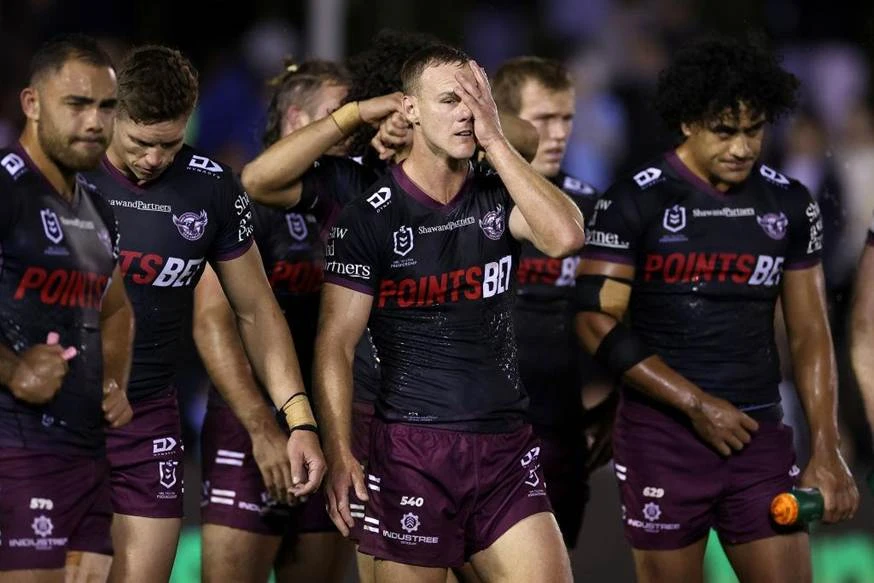
On 2 April 2026, the Albanese government announced a narrower but still significant package: caps and bans on TV and radio gambling ads, restrictions on online ads unless users are logged in, over 18 and able to opt out, bans on celebrity and sports-player appearances, bans on odds-style ads targeting sports fans, and bans on gambling ads in sports venues and on players’ and officials’ uniforms, with reforms to begin from 1 January 2027.
Advertising is one of the few structural advantages the legal market still holds over the illegal one and these restrictions materially narrow that gap. Notably, the April 2026 package did not implement the committee’s recommendation for a single national online gambling regulator. That leaves Australia’s layered federal/state framework intact, while offshore operators continue to sit outside it.
PointsBet branding on Manly Sea Eagles jerseys. Under the announced reforms, gambling logos on uniforms will be banned from 2027. Source: Cameron Spencer/Getty Images
Enforcement is active, but structurally limited. ACMA has blocked more than 1,500 illegal gambling websites since 2019, but blocked sites can reappear under new domains. Distribution runs through channels outside any single regulator’s reach. Payments flow through rails beyond the banking system. The pressure falls most clearly on the visible, regulated parts of the market.
H2’s consumer survey found three in five Australian online players had seen advertising for illegal offshore gambling, most commonly through social media and influencer content. Half of those using illegal offshore sites were registered with BetStop. They opted out of the regulated system, not gambling itself.
Distribution edge
Offshore operators are shut out of traditional channels, but they have become fluent in the distribution logic of the algorithmic internet. That is where the advantage sits for reaching the next generation of customers. Gambling streams, clipped highlights and affiliate content can spread across Kick, TikTok, Instagram and X at low marginal cost, especially when they are packaged as entertainment rather than conventional advertising.
Kick, the livestreaming platform built by the Easygo team behind crypto casino Stake, recorded 4.5 billion hours watched in 2025, up 131% year on year according to Stream Hatchet. Similarweb shows its largest audience segment is aged 18 to 24. Bloomberg Businessweek reported in February 2026 that one high-profile streamer appeared to have received at least 26,000 Ether from Stake between November 2021 and March 2025 (about US$78 million at transaction-time exchange rates) and that Stake paid clippers $500 per million views before raising the bounty to $800 in late 2025.
The reach extends beyond gambling content. Casino-sponsored influencers on Kick stream everything from fighting promotions to chatting up strangers on camera. A teenager searching for gym workouts or boxing highlights is one algorithm step away from a streamer whose entire channel carries casino branding. Louis Theroux’s ‘Inside the Manosphere’ captures exactly this dynamic. In a single social-media session, a teenager can see more casino branding than a licensed operator can buy in a month of television ads.
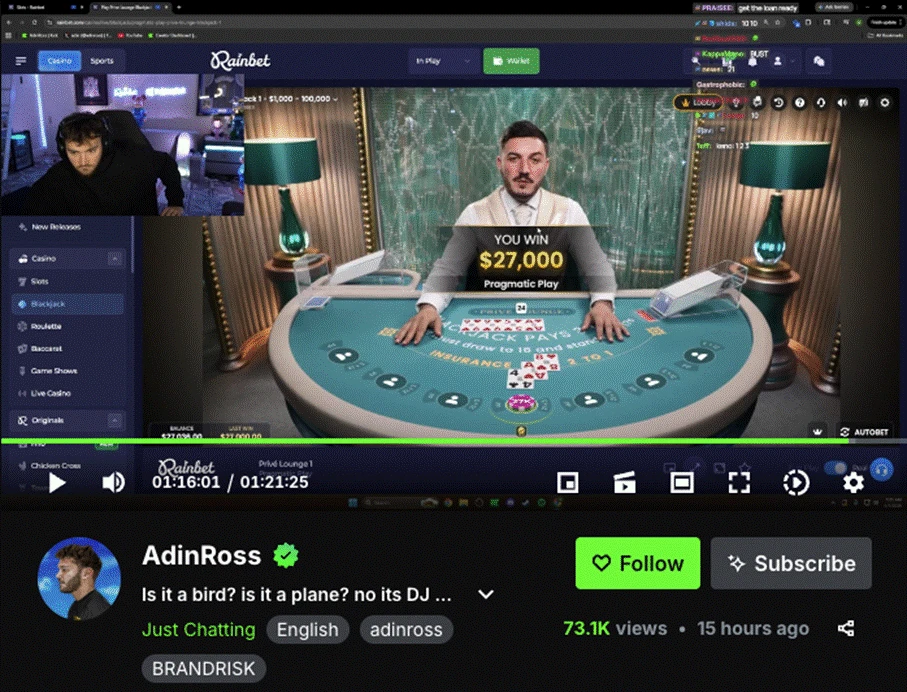
Popular streamer Adin Ross playing blackjack to his audience on Kick. Source: Kick
Operator squeeze
Australia was already a high-cost operator market before the April 2026 advertising package. H2 estimates that racing fees, sports fees, point-of-consumption tax, GST, corporate income tax and other charges together amount to roughly 40% of gross gaming revenue, or 54.4% of net win.
Compliance pressure has also risen. AUSTRAC commenced civil penalty proceedings against Entain in December 2024 alleging serious and systemic AML/CTF failures, while Crown was ordered to pay an AU$450 million penalty in 2023. And now the advertising restrictions are narrowing the last major acquisition channel available to the regulated market. Operators are being squeezed on tax, regulation and customer acquisition at the same time.
Opportunity
Regulation is shrinking the regulated market, but not demand. That demand is moving offshore into higher-margin products the legal market cannot offer. Licensed operators are being squeezed: acquisition is harder, monetisation is narrower and costs remain high, while offshore competitors operate with structural advantages.
As a result, competitive advantage shifts away from marketing and toward the quality of the product and underlying infrastructure. The value moves to the suppliers that improve conversion, payments, risk and retention. That is increasingly where competitive advantage sits. It is also the supply chain Waterhouse VC backs – the infrastructure supporting regulated operators.
Tom Waterhouse reported on the Evolution regulatory struggles last month.

Waterhouse VC invests globally in publicly listed and private companies across the wagering and gaming ecosystem. The Fund is available to wholesale investors only.
Since inception (August 2019), Waterhouse VC has achieved a gross total return of +3,653% (75% p.a. annualised) as at 31 January 2026, assuming reinvestment of all distributions.
Original article: https://igamingbusiness.com/sustainable-gambling/waterhouse-vc-business-plan-illegal-australia-gaming/