








In this article, Turbo Stars explores how operators can unlock sustainable growth by shifting focus from high-value “whales” to the larger, often underutilized segment of mid-tier players.
High-value players have always held the center of casino retention strategy. The logic is simple: find the 1% of players who deposit thousands, and they’ll cover the cost of acquiring the others.
It’s a proven model that is also… increasingly broken.
The problem isn’t the whale itself — it’s the assumption. With acquisition costs rising steadily, the model works only if whales are big enough to “pay” for everyone, while the rest of the player base generates just enough to break even. The brand becomes dependent on those VIP players, which ends up in overestimated marketing budgets, broken engagement funnels, and so on.
Across dozens of operators and markets, Turbo Stars sees the consistent pattern: the brands scaling fastest aren’t chasing whales harder — they’re monetizing everyone else.
The math of VIP vs. mid-tier
What is “whale” or VIP?
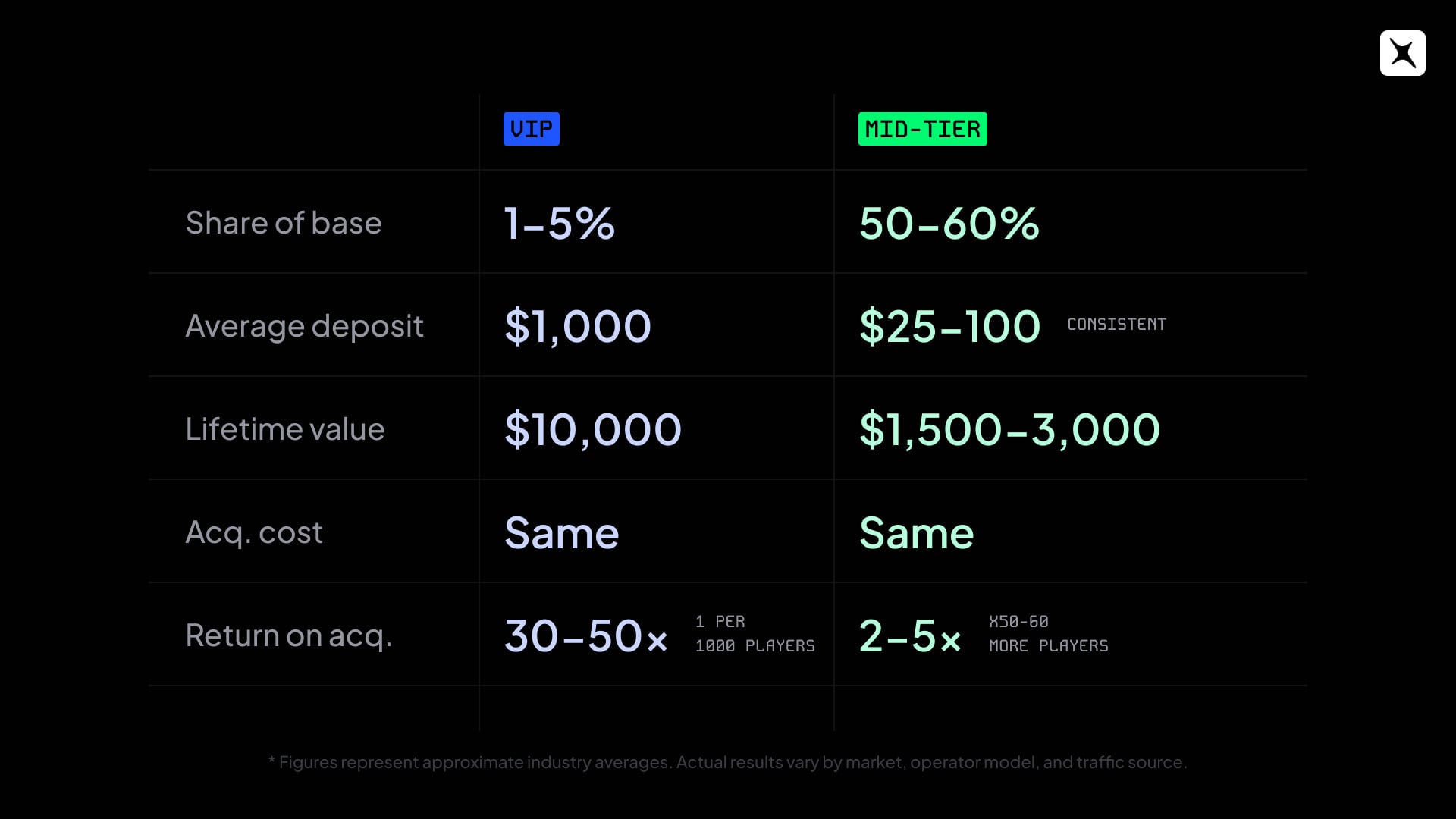
It is a player with the highest lifetime value ($10,000 or more) who is ready to deposit big, play regularly, and stick around for months — delivering a 30–50x return on acquisition cost.
The issue is that such players are rare. Operators need to acquire a thousand small players to find one. Most of those thousand generate $25–100 deposits, play a few times a month, and leave with $500–1,500 lifetime value. Same acquisition cost, 2–5x return.
Meanwhile, there’s another audience segment that wants to be entertained.
Mid-tier players are the 50–60% of any player base sitting between whales and casual players. They deposit $25–100 consistently over weeks and months. Not chasing big wins, mostly playing for entertainment with LTV around $1,500–3,000. Acquired for the same cost as everyone else, they come back and spend consistently. Their cohort is 50–60 times larger than VIPs.
So, how to engage them?
How this actually works
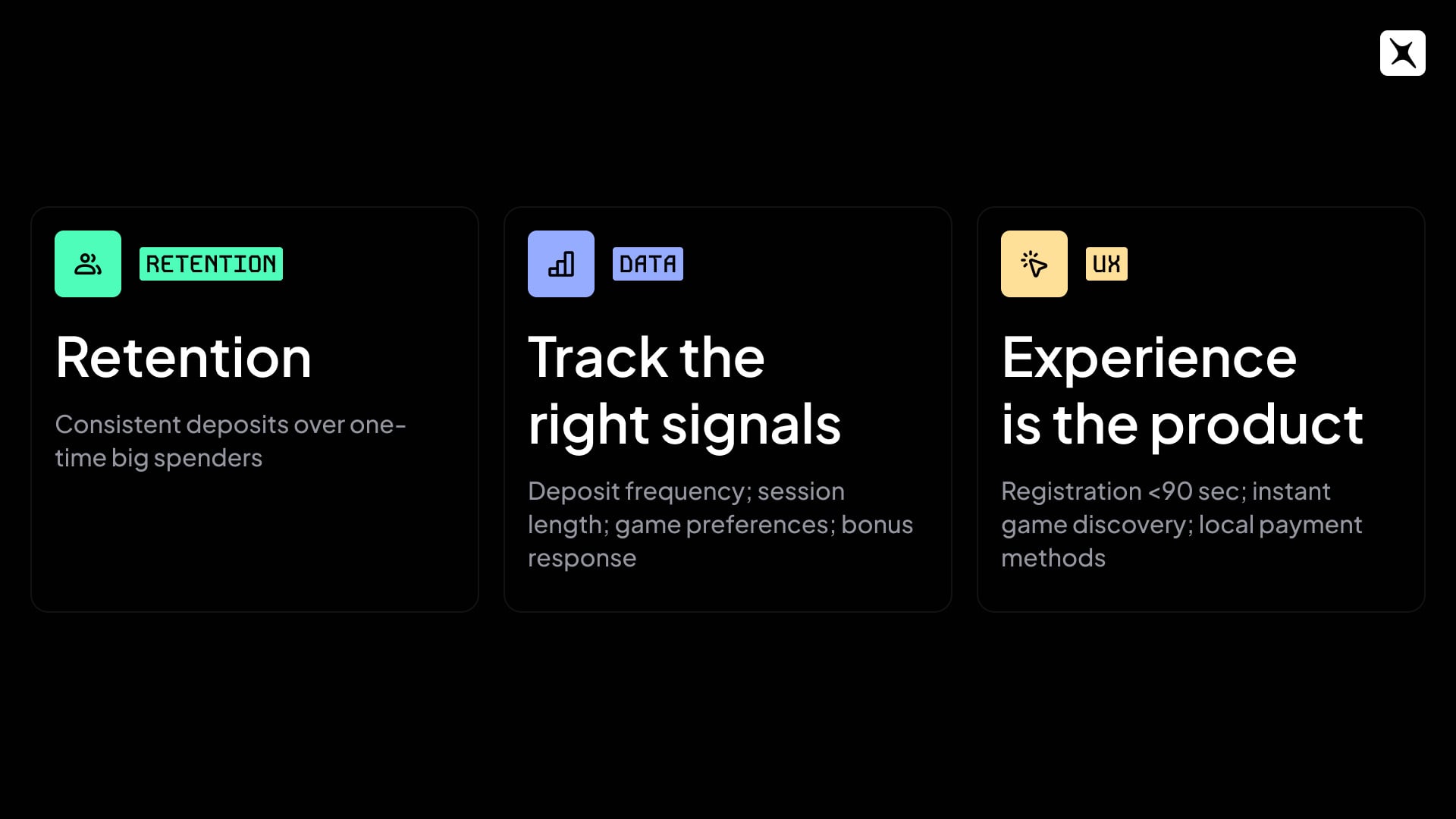
Creating a strategy for mid-tier players isn’t about ignoring whales. It’s about treating the majority of players as the revenue base they are. From Turbo Stars’ perspective, there are three main differences in overall approach:
Data that works across all cohorts
The data priorities are different for each tier. Whale hunting tracks indicators of high potential: average bet size, deposit amounts, session frequency in the early stages — signals that a player might be worth pursuing.
Mid-tier monetization reads different signals: deposit regularity, session length, game category preferences, and bonus response rates. Not “is this player big?” but “is this player consistent?”
Retention mechanics for mid-tier engagement
Once operators understand these signals, they provide suitable offers that reward not total spend but deposit frequency over time.
It means:
● bonus structures calibrated to $25–100 deposits (not whale thresholds),
● offers timed to when a player actually shows up (bonuses hit Wednesday if they deposit on Thursdays),
● game recommendations based on what they actually play, not what’s being promoted, and
● loyalty mechanics that encourage consistency.
UX that doesn’t waste their time
Whales usually tolerate technical nuances because they’re committed. Mid-tier players don’t. They have options — and they use them. Any weird and uncomfortable experience anywhere in the funnel could be an exit.
That’s why the experience has to be seamless end-to-end. Registration under 90 seconds, instant game discovery, payment methods that match how players in that market actually move money. The difference between 40% and 60% reg-to-FTD conversion often comes down to 30 seconds of technical friction.
The bottom line
The math is obvious, as an idea behind it:
Entertainment is the product for the majority of players. Most will never become whales — and they don’t need to.
Mid-tier players don’t need luxury treatment. They need to see that the platform is built for them. Regular bonuses that match their spending. Game recommendations based on what they actually play. Onboarding that doesn’t waste their time.
The 50–60% were always there — they just weren’t the priority. Operators who understand and reflect that — with data, retention mechanics, and UX built for normal players — are the ones growing.
That’s exactly what Turbo Stars built its platform around.
Original article: https://www.yogonet.com/international/news/2026/04/16/118588-the-midtier-player-opportunity-entertain-more-earn-more