








In this article, Dominator Play explores how integration speed, operational alignment, and post-launch promotional execution are becoming decisive factors in turning iGaming content from a technical rollout into immediate revenue generation.
Who can argue that, in the iGaming business development, time is money leaking or money made? Even to look outside the industry, for 46% of companies (Monetization Monitor), delayed time-to-market is the #1 barrier to revenue growth. Different verticals, same outcome: speed quietly decides who gets paid.
Integration determines how quickly a game changes from a “ready” status to an “earning” one. It’s the moment when a product stops being a cost and starts being revenue. Beyond just being roadmap eye candy, fast go-live is liquidity.
Content can come from any provider. The difference is which partner actually solves operator-side problems instead of shipping another slot into the lobby. That’s where Dominator Play, an iGaming development studio, behaves differently. It centers on operator metrics, both technically and operationally, adapting content for different segments and turning a new release into visible revenue.
What actually slows down integration (spoiler: it isn’t the tech)
Integration rarely breaks because of “complex systems.” That’s the comfortable story. The real one is less technical and more human.
Sharing his thoughts on the topic, the Dominator Play CPO, Constantin Molodtov, says that the first slowdown is dependency on the operator’s internal flow. In standard iGaming integration services, a provider hands over API docs and waits. Then it waits for prioritization. Then it waits for kick-off and QA. Nothing is blocked technically, but everything is blocked structurally. You’re inside someone else’s queue, and queues don’t care about your launch date.
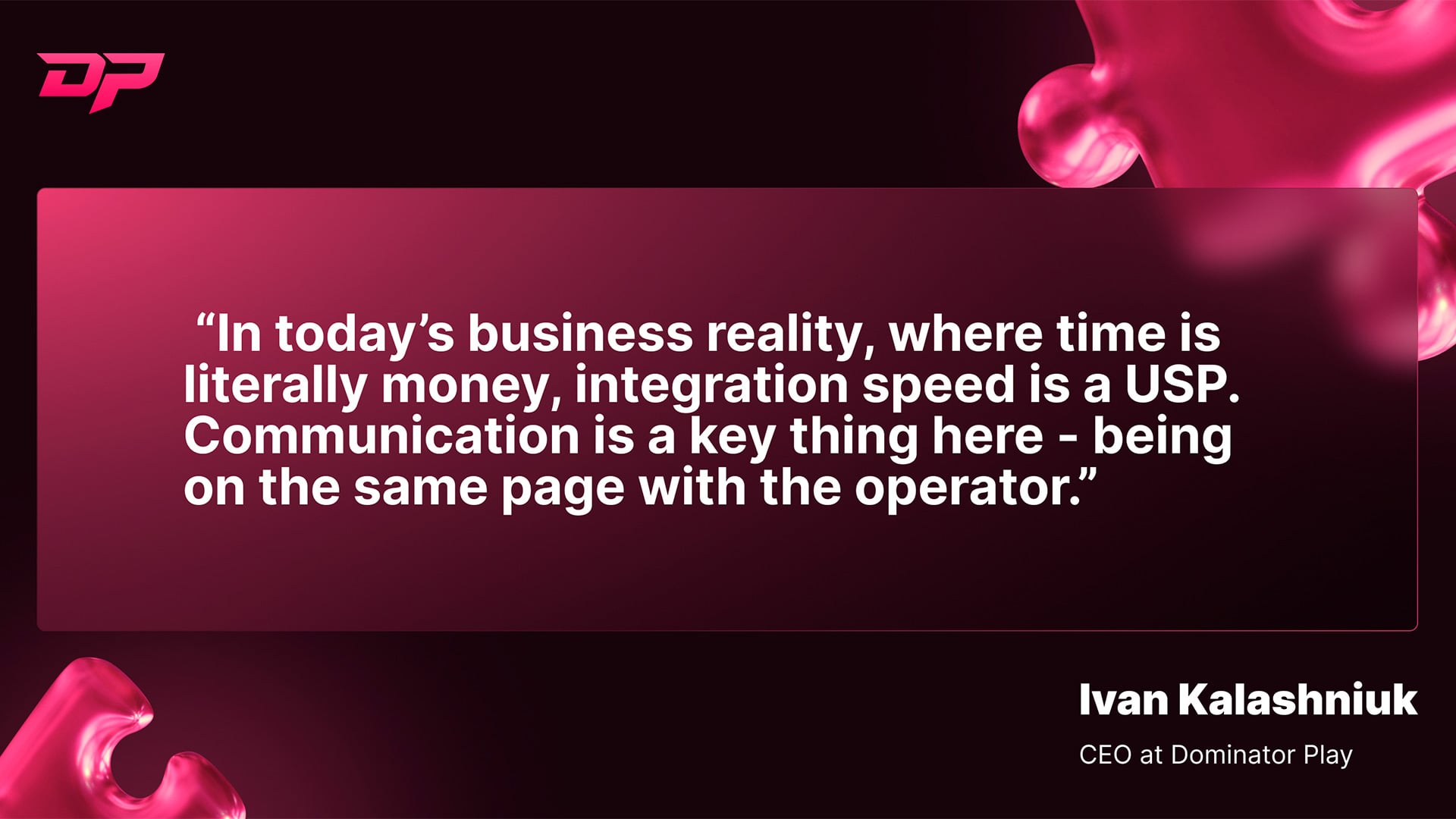
The second one is communication latency. According to Ivan Kalashniuk, CEO at Dominator Play, that one “we’ll check internally” is enough to stop progress in iGaming deals for days or even weeks. Two teams are trying to sync decisions across time, tools, and priorities. Multiply that across a few threads and “fast integration” turns into a slow conversation.
The third is misalignment on the iGaming API integration clarity. If documentation leaves room for interpretation, it becomes delayed.
Finally, fragmented ownership. When it’s unclear who owns the next step, a provider or an operator, work doesn’t move. That’s the worst kind of delay: everything looks “in progress,” but nothing is progressing, as seen in Ivan Kalashniuk’s experience.
Standard vs reverse integration: Same goal, different control over time
The standard iGaming integration model puts the operator in charge of building the connection. A developer provides API documentation, and an operator implements it on its side. The timeline can inherit an operator’s internal reality: backlogs, priorities, release cycles, etc.
Reverse integration allows a provider to use an iGaming partner’s API and integrate products directly into its system.
That means:
-
localization updates done in flow without review cycles;
-
promo tools configured directly;
-
custom currencies integrated as part of the wallet setup;
-
regulatory adjustments handled on the spot.
Every new addition to a casino’s portfolio stops being an operator’s “internal project.” It solves one of the main pain points: in iGaming partnerships, operators don’t want more of these projects; they want more live content.
There isn’t a winner here. Standard integration gives operators more control. Reverse – removes back-and-forth moves that eat up a lot of time and profit.
Why speed matters for both sides of the contract
Slow integration is expensive for everyone involved.
Ivan Kalashniuk draws the line clearly:
For providers, the cost is obvious if you look at it without filters. The game is already finished, certified, and technically ready to generate revenue. Yet, until it goes live, it produces nothing. Each extra week inside integration is a finished iGaming sales asset sitting idle.
Operators feel it differently, but no less sharply. There are plenty of developers in the market, but the real difference is whether they remove complexity or add it. There’s a clean example with Dominator Play. Understanding operators’ pain points, it takes away friction where they usually expect it. This can result in lengthy implementation cycles, inconsistent API standards, complex certification requirements, and dependency on technical alignment iterations.
Based on accumulated experience, Dominator Play builds a ready-to-use integration process that reduces these bottlenecks from the start. Both standard and reverse integrations give casinos flexibility in their choice. Branded games follow the same idea – to provide a room for stronger brand expression. They clear the barrier of standing out in the crowd, allowing operators to highlight their own brand identity.
Plus, after the integration, games are supported from day one with promotional campaigns. Streamer activity, UGC, influencer exposure, and affiliate distribution work together. The result is immediate visibility and early momentum instead of a slow organic build. Influencer marketing alone drives around 37% of conversions, while UGC can lift them up to +30-200%, depending on execution and reach. That’s the mix Dominator Play is built around: focusing on the post-integration outcome.
That first wave matters. Players exposed to a game through creators and promos tend to engage on the initial platform where they see it. Once they play game X on platform Y, they get this shot of novelty there and won’t actively seek alternatives.
In this setup, the speed of game integration becomes an advantage, but it’s only the first step. Whoever goes live with full promotional coverage takes the cream of this product’s iGaming revenue.
As Constantin Molodtov puts it, reality leaves no room for pause:
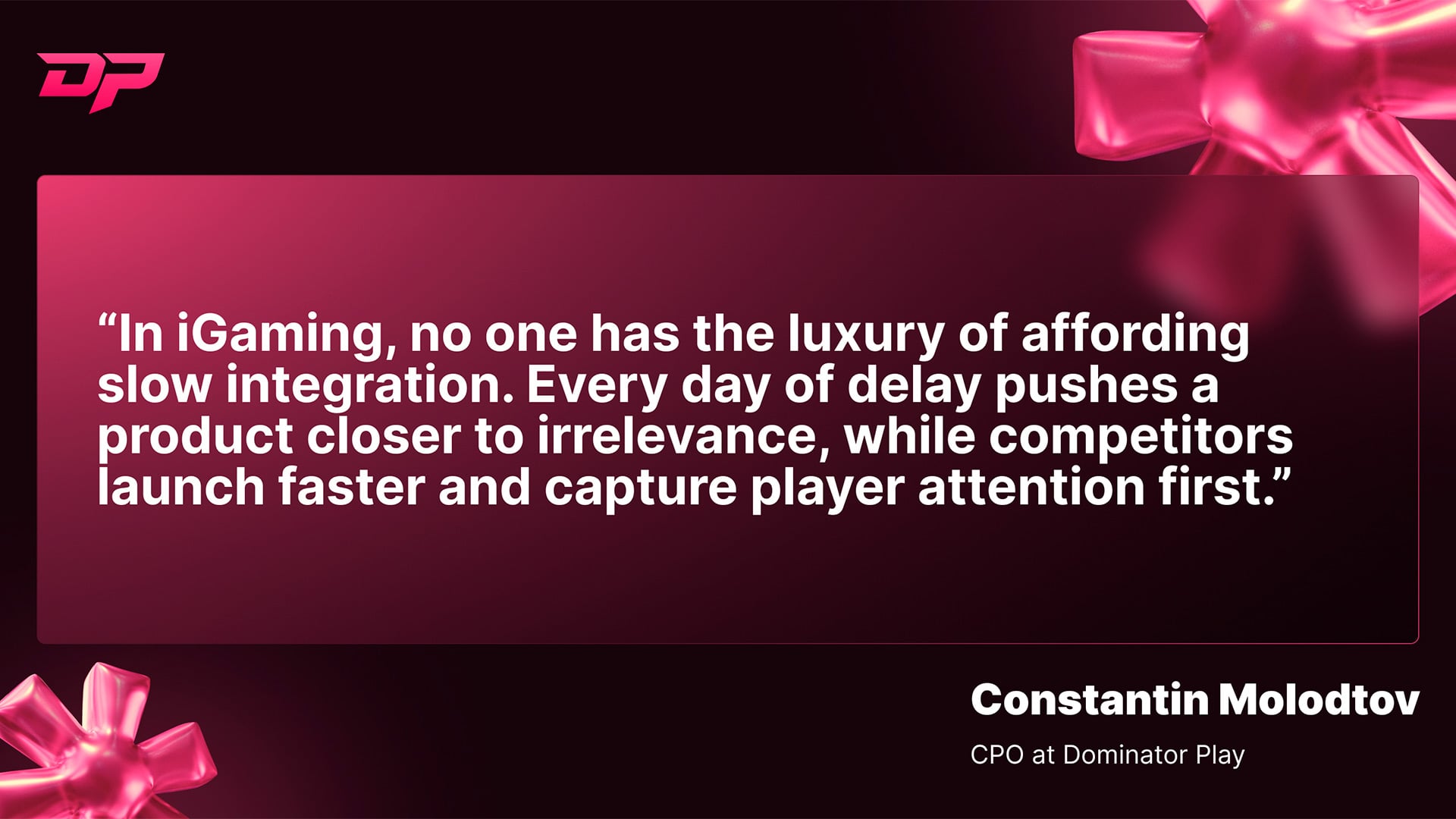
In strategic partnerships in iGaming, the first to go live captures the richest slice of revenue. If a game takes weeks or months to integrate, it doesn’t arrive in a neutral market. It arrives at a point where another operator has already launched it, backed by provider-side promo, and locked in player engagement.
Revenue is there for everyone, but it’s never split evenly. It depends on timing, partners, and execution. Dominator Play keeps you closer to the start of the action, not the part where everyone’s already settled in.
Original article: https://www.yogonet.com/international/news/2026/05/15/120615-time-matters-why-game-studios-cant-afford-slowmo-integration