








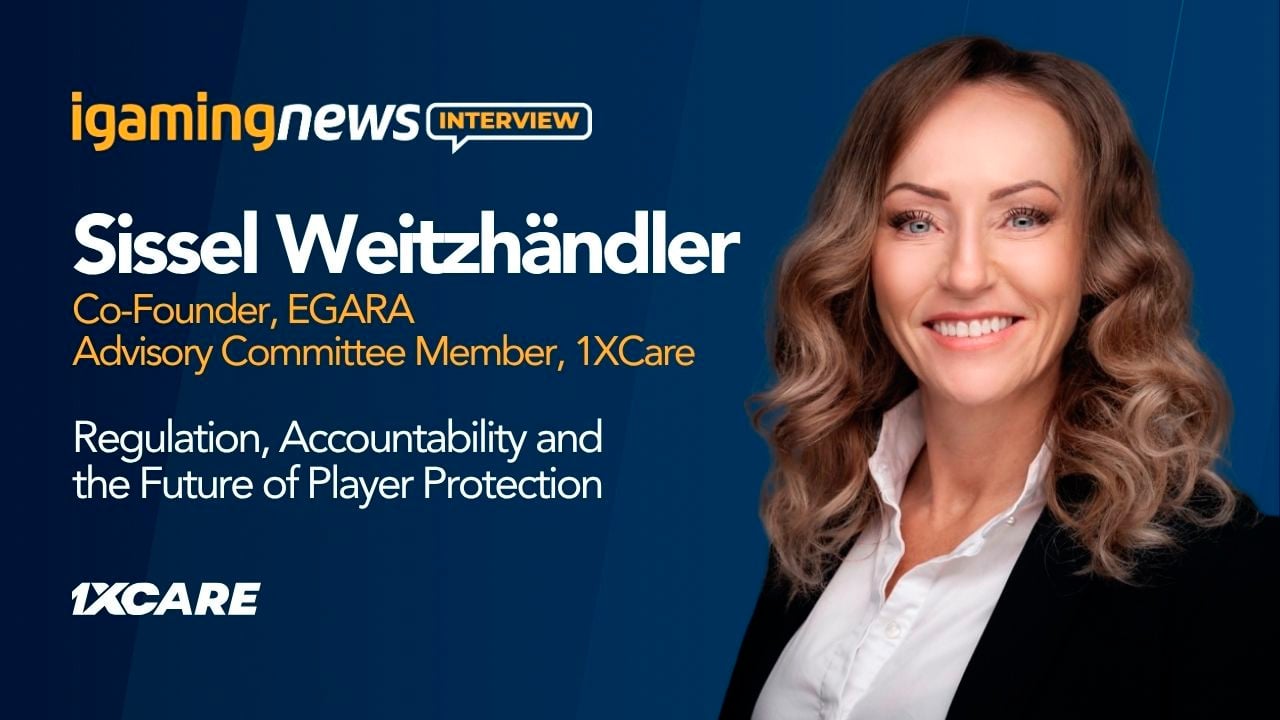
This interview was originally published by iGaming News. In it, 1xCare Advisory Committee member Sissel Weitzhändler discusses her career in gambling regulation, responsible gambling and the organisation’s approach to public-interest funding.
Sissel Weitzhändler has built her career at the intersection of public policy, regulation and the gambling industry, developing expertise across licensing, governance, AML, market-entry strategy and player protection.
Now serving on 1xCare’s Advisory Committee, she brings that experience to an initiative focused on supporting public-interest projects and strengthening accountability around responsible gambling. With an emphasis on independent decision-making, evidence-based funding and transparency, Sissel is focused on ensuring initiatives deliver meaningful and measurable outcomes.
In this exclusive Women in Gaming interview with iGaming News, Sissel discusses her journey into gambling regulation, what she looked for before joining 1xCare, and how the organisation plans to demonstrate the impact of its work. She also reflects on the changing role of women in gambling policy and regulation, why diversity matters in player-protection decisions, and what success for 1xCare could look like as it moves towards 2027.
You have built a career in public policy and regulation. What first drew you to that work, and what led you into the gambling sector specifically?
I was drawn to public policy because it sits at the point where ideas become consequences. It is not abstract for long: a rule, a licensing decision or a regulatory standard eventually changes how a business operates and how people are protected.
My academic background in International Relations and War Studies taught me to look closely at institutions, incentives and the gap between stated principles and practical reality. I became interested in the systems behind decisions: who has authority, what evidence is being used, and whether a framework can genuinely deliver its stated purpose.
Gambling brought those questions into sharp focus. It is an international industry, but it is regulated market by market, with very different expectations around consumer protection, integrity, technology, financial crime and corporate responsibility. Good regulation has to be practical enough to work in a real commercial and product environment, while being robust enough to protect the public interest.
Over time, my work became less about interpreting rules in isolation and more about helping businesses build systems that can withstand scrutiny – licensing structures, governance, technical controls, AML frameworks and market-entry strategy. That is still what interests me most: making regulation operational, rather than treating it as something considered only at the end of a project..
1xCare is funded by the owner of the 1xBet brand but governed independently through its Advisory Committee. What did you want to satisfy yourself about before agreeing to join?
I wanted to understand whether independence, in particular my own freedom to make independent decisions, was built into the structure, rather than assumed. My questions were practical e.g. where do funding decisions sit, can the committee challenge or redirect a proposal, and how will uncomfortable findings be handled?
What gave me sufficient confidence to participate was the built-in separation between the funder and programme decision-making, together with a committee remit focused on funding, accountability and evidence. But governance has to prove itself in practice. The real test is whether that structure continues to hold when decisions are difficult or findings are inconvenient. .
Your role covers public policy and regulation, including funding for public-interest initiatives and NGO accountability. In practical terms, what does that oversight involve?
In practice, oversight is less about grand strategy and more about disciplined questions. What is the funding intended to achieve? Is the recipient credible and appropriately governed? What evidence will demonstrate progress? And are the activities appropriate for the regulatory and social context of the markets they touch?
My role is to bring a public-policy and regulatory lens to those decisions. That includes considering accountability, transparency, potential conflicts, and whether programmes are designed to produce evidence that is meaningful beyond a press release.
1xCare attaches accountability standards to every grant it makes. What does a credible standard look like, and what happens when a funded organisation falls short?
A credible standard starts before any money moves. We agree what the grant is for, what success would look like, and how it will be measured. Vague objectives make weak accountability, so we try to be precise at the outset.
Recipients report against those terms, and the reporting has to be honest about what did not work as well as what did. I would rather fund an organisation that tells me plainly where it struggled than one that reports only good news.
When an organisation falls short, the response depends on why. Genuine difficulty in complex conditions is one thing; a failure of integrity, transparency or material compliance is another. The response should be proportionate and may include additional reporting, a corrective-action plan, suspension of further payments, or termination where the grant terms allow.
The committee holds authority over funding allocation. How does the committee maintain that the decisions are made independently of the commercial brand that provides the funding?
The committee’s responsibility is to decide how resources can best be deployed in pursuit of 1xCare’s objectives. In doing so, we assess priorities, evidence and expected impact, and allocate resources accordingly.
If research findings or programme outcomes point us in a particular direction, they are considered on their merits. The question for the committee is not what best serves the commercial interests of the funders, but what will best advance 1xCare’s objectives and deliver the greatest impact.
Ultimately, the basis on which decisions are made remains the same regardless of where the funding comes from.
Responsible-gambling funding is often criticised as hard to trace. What will make 1xCare’s funding transparent to a regulator or an outside observer?
1xCare has committed to regular impact reporting, meaning that it will be reporting on the projects and initiatives it supports both in terms of what was done and what was achieved. Every project therefore will undergo an assessment and evaluation and outcomes will be published. We are planning to publish the first of these reports in 2027.
You describe the work as evidence-based. Where the evidence is thin or uncomfortable, how should that change what gets funded?
Where evidence is thin, the answer should not be to fill the gap with confidence. It should be to fund cautiously, define the learning objective, and avoid scaling an intervention simply because it appears intuitively attractive.
Where findings are uncomfortable, they should inform future decisions rather than be treated as an inconvenience. Evidence-based work means being prepared to modify, pause or stop funding where the expected impact is not being achieved.
It also means publishing results in a way that is useful to others. The objective is not merely to demonstrate activity; it is to improve the quality of future interventions.
Policy and player protection are areas where women are comparatively well represented, yet commercial and board leadership is not. Why does that gap persist, and does it matter for how the industry protects players?
Leadership representation is shaped by a range of factors, including career pathways, professional networks, perceptions about who is suited to revenue-generating roles, and access to sponsorship and opportunity. I am therefore not sure I can give a definitive answer to why certain gaps persist.
That said, I’m not sure the most important question for player protection is whether policy and player protection roles are held by men or women. For me, the more important question is whether player protection has a meaningful voice in decision-making and whether its recommendations are taken seriously.
Any organisation can establish specialist functions, policies and committees. The real test is whether player protection considerations are reflected in commercial, operational and strategic decisions across the business. From that perspective, what matters most is not the gender of the people involved, but whether player protection is treated as a core responsibility of the business rather than a peripheral one.
Over your career, what has genuinely changed for women in gambling regulation and policy, and what has not?
What has genuinely changed is visibility. There are more women in senior regulatory, policy, compliance and public-affairs roles than when I began working in the sector. There is also a stronger recognition that regulatory and player-protection expertise is central to the industry, rather than peripheral to it.
I have seen women build real authority through substance: understanding complex regulation, working across jurisdictions and being willing to ask difficult questions while a project is still taking shape. During my time at Allwyn, I worked alongside women in senior investment and finance positions whose leadership and commercial judgement taught me a great deal. That experience is important, because it shows that progress is possible when expertise is matched by opportunity and influence.
What has changed less consistently is the distribution of influence at the highest commercial and board levels. There are clear exceptions, but female representation still tends to thin out in the rooms where capital allocation, product strategy and growth decisions are made.
That matters because the decisions most affecting player protection are not only regulatory decisions. They are also commercial and product decisions. If people with experience of regulation, risk and harm are brought in only after the strategy is set, their influence is inevitably limited.
I would be careful not to generalise too broadly. Progress differs between companies and markets. But my own experience is that expertise creates leverage: the more technically strong and commercially literate women become, the harder it is to treat their contribution as purely advisory. The door is more open than it was, but the most influential rooms can still be the hardest to enter
Does a more diverse committee reach better decisions on player protection, or is that claim overstated?
I want to answer this carefully, because it is easy to overclaim. Diversity does not guarantee a better decision. A diverse group can still get things wrong, and a homogeneous one can occasionally get them right.
What diversity does more reliably is widen the range of questions asked before a decision is made. It makes blind spots less likely, because the people around the table have seen harm and risk from different angles. On player protection that matters, since the failures usually come from the risk nobody thought to name.
Diversity is not a guarantee of the right answer. It is a safeguard against the wrong answer going insufficiently examined
What would you say to a woman early in her career who is weighing public policy or regulation in this sector?
I would tell her that the work is worth doing, but that influence in policy and regulation is often gradual rather than immediate. The wins are not always visible and the credit does not always land where it should.
Two practical things matter. First, learn the substance deeply about regulation, product, technology and the commercial model, because real expertise is difficult to dismiss. Second, do not wait for complete certainty before contributing. In difficult discussions, the question you are reluctant to ask is often the one that needs to be heard.
And build a network of people who will give honest feedback, not only encouragement. No one builds a durable career in this field alone
Twelve months from now, what would tell you your stream had made a real contribution rather than a symbolic one?
In twelve months, I would want to be able to point to specific decisions, explain the public-interest rationale for them, and show what has actually been delivered or learned. That includes being clear where results were mixed or an intervention did not perform as expected.
I would want accountability standards to have been applied in practice, not simply described in a framework. And I would want the reporting to show more than activity: what was funded, what evidence was collected, what changed as a result, and what decisions were made in response.
If all we can point to is launches, statements and good intentions, then the contribution will have been symbolic. The meaningful test is whether the work can be independently examined and whether it has improved the quality of the decisions that follow.
Original article: https://www.yogonet.com/international/news/2026/08/19/125953-good-regulation-has-to-be-practical-enough-to-work-in-a-real-commercial-environment