







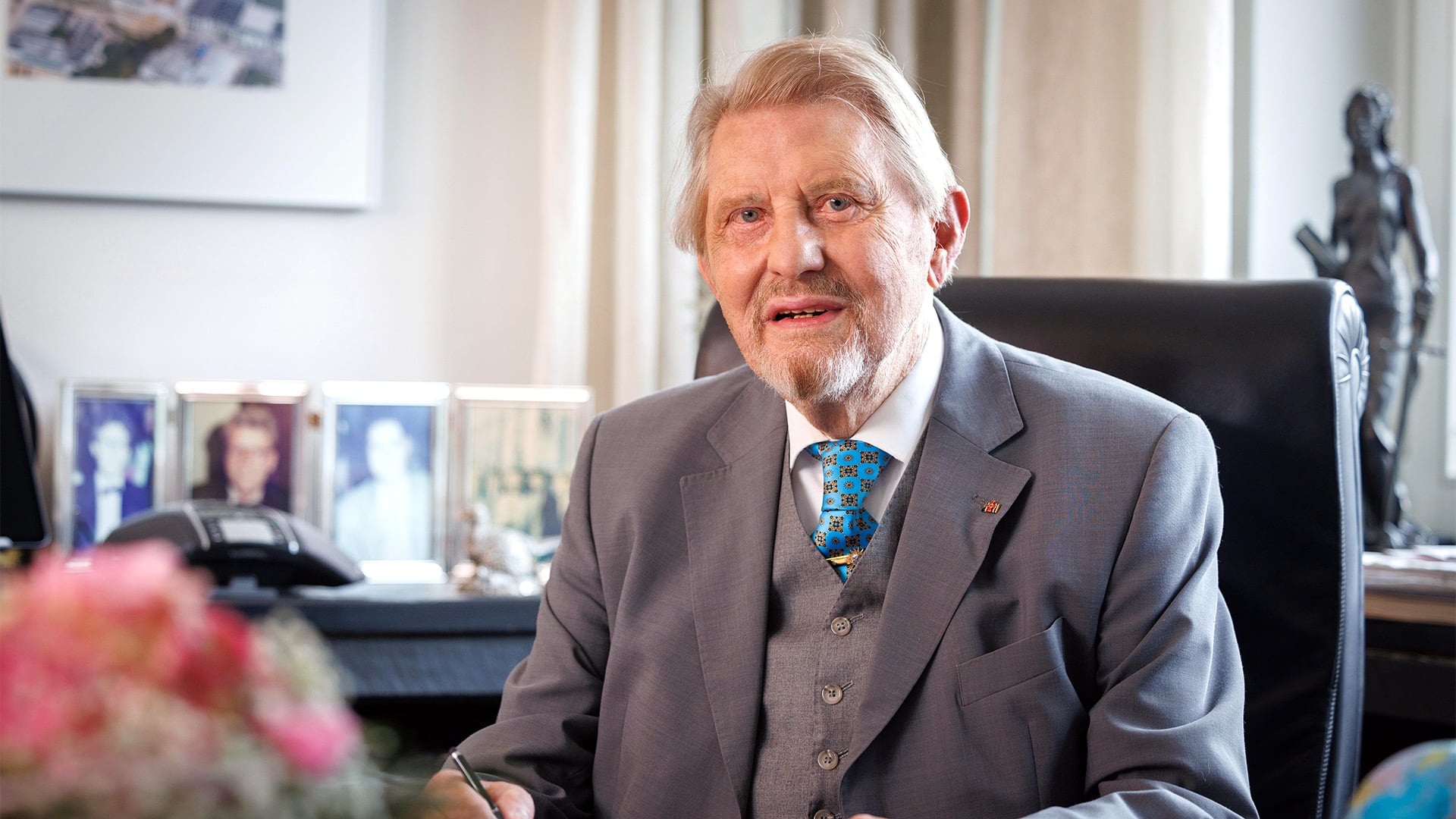
Paul Gauselmann, founder and long-time Chairman of the Board of the Merkur Group, passed away today, Friday, shortly before his 92nd birthday. Born in Westphalia, he built up a one-man business after the Second World War into an international Group with more than 15,000 employees and a total turnover of around 2.1 billion euros.
For 67 years, he shaped the company; for decades, he also acted as an advocate for the German gaming machine industry as a whole. In 2003, he was awarded the Federal Cross of Merit, First Class, and in 2004 he was distinguished as an honorary citizen of the cities of Espelkamp and Lübbecke.
Paul Gauselmann is survived by his wife, Karin, four sons, nine grandchildren, and seven great-grandchildren.
“He was an extremely popular company director, an inspiring leader through and through,” Merkur Group said in a statement. “Even as Group head, PG was always happy to take the time for a quick chat with his staff, regardless of their role within the company.”
“A word of appreciation here, an interested enquiry there – Paul Gauselmann always treated everyone with respect. His experience as an employee himself taught him just how important appreciation and communication on an equal footing are. He remained true to this guiding principle throughout his life.“
Paul Gauselmann was born in 1934 in Borghorst near Münster (Westphalia, Germany). At the age of just two, he lost his mother and was subsequently raised by relatives in Münster, separated from his father and his four brothers. He was five years old when the Second World War broke out. As a young boy, Paul Gauselmann experienced devastating air raids, constant fear and great hardship.
These experiences taught him at an early age to improvise and stand his ground. During the long nights when he couldn’t sleep because of the air-raid sirens, he also came to appreciate the value of the game. “We simply used games to pass the time and take our minds off our fears,” he once said.
In 1950, he graduated at the top of his class and began an apprenticeship as a telecommunications inspector, after which he was quickly promoted to head of his own inspection department. In 1956, he started working for a vending machine manufacturer from Coesfeld, who was also the general importer for American Wurlitzer jukeboxes.
During this time, Paul Gauselmann developed the first remote selection unit for German jukeboxes, which he presented to Harting, the Espelkamp-based jukebox manufacturer. Soon after, he was hired as a technician and just four years later, at the age of 26, was promoted to head of the machine development department. This was the start of the Paul Gauselmann story in Espelkamp, his adopted home, with his young family.
In 1957, he took on a part-time job as a self-employed jukebox operator, which in 1964 led to him becoming fully self-employed as an operator of gaming machines in the hospitality industry. Commercial machine gaming was largely out of the public eye at the time. He wanted to change that: in 1974, the 40-year-old opened his first gaming arcade in Delmenhorst, Lower Saxony, to the standards of a four-star hotel.
His first slot machine, developed in-house – the Merkur B – took the German market by storm in 1977 and provided the initial impetus for the Group’s rapid growth. This was followed by countless further in-house developments, hundreds of patents and a decisive move into the international market.
In addition to making his own company a success, Paul Gauselmann was also always focused on the welfare of the entire amusement and gaming machine industry. As early as the 1960s, he played a decisive role in shaping industry policy within the trade associations, and did not shy away from conflict in the process. He sought eye-to-eye contact with the aim of talking to others in the industry directly, rather than about them.
For over 38 years, he shaped the industry, 28 of which as Chairman of the Board of the Association of the German Vending Machine Industry (Verband der Deutschen Automatenindustrie e.V.), and played a decisive role in its development into a major economic sector.
Of the Merkur Group’s current workforce totalling more than 15,000 members, over 2,000 are based in Espelkamp and Lübbecke. This makes the company one of the most important employers in the Minden-Lübbecke economic region.
To secure the Group’s future for generations to come, the shares in the entire Gauselmann family’s companies were transferred to the Gauselmann Family Foundation in 2016, which is the sole owner of the Merkur Group. Paul Gauselmann remained Chairman of the Foundation’s Board until 2024. He then handed over the reins to his son, Michael Gauselmann, sending a clear signal that the Group would continue as a family-run business.
“My family is the most important pillar in my life, both personally and professionally,” he never got tired of emphasising. He met his wife Karin on a winter holiday in 1967. Before long, the Berlin-born woman followed him to the tranquil town of Espelkamp, became his closest confidante and filled the void in the lives of his three sons – Peter, Michael and Armin – that had been left by the death of their biological mother. In 1969, their son Karsten was born.
Right up until the end, Paul lived with Karin Gauselmann in their home in the Espelkamp countryside, surrounded by the nature that he loved so much.
Paul Gauselmann himself always gave something back and supported numerous projects in the fields of social welfare, culture, sport and health. He also established the Paul Gauselmann Foundation charity, which later, together with his wife Karin, became the Paul and Karin Gauselmann Foundation – into which his entire personal fortune and that of his wife shall be transferred.
Karin Gauselmann will continue his work even after his death, thereby ensuring that part of Paul Gauselmann’s character lives on forever. In recognition of his social commitment, he was distinguished with honorary citizenship by the cities of Espelkamp and Lübbecke in 2004; in 2003, he was awarded the Federal Cross of Merit, First Class, by the then-president of Germany.
With the acquisition in 2010 of the dilapidated 500-year-old Schloss Benkhausen in Espelkamp, just a few kilometres from his home, he created an enduring monument to his life’s work. Following extensive refurbishment work, a modern training centre with hotel facilities was created, and an old barn on the estate houses the German Coin-Op Museum – Gauselmann Collection.
He also showed particular commitment to supporting healthcare and emergency care projects in the Minden-Lübbecke district, as well as various amateur and professional sports clubs. He had a particular passion for tennis: at his local tennis club, Espelkamp-Mittwald e.V., he was involved as a sponsor and honorary chairman, and was himself an active member of the club’s team.
Even in his later years, he remained tireless in his social commitment. Not only did he fund the construction of two childcare centres in Espelkamp with an investment of around 6 million euros; when the town recently found itself in financial difficulties through no fault of its own, he stepped up once more with a donation of 8.7 million euros.
To ensure the neighbouring town of Lübbecke, where the Merkur Group’s production plant is located, was not left behind, he contributed an additional 5 million euros. In a matter of just a few months, Paul Gauselmann thus contributed around 20 million euros to the public good.
“As an old-fashioned entrepreneur, he had always lived frugally; material wealth had never been the primary driving force behind his actions,” Merkur Group stated. “He took pleasure in helping people and making the region a better place to live – whether through new childcare facilities, fire engines or better medical care.”
“For everyone who knew Paul Gauselmann, the loss of him is still too much to take in. Yet, as he would have wanted, our gaze is fixed on the Merkur sun,” the company said in its obituary. “Now it is time to say farewell to Paul Gauselmann. The Merkur Group, together with its staff members, pays its respects to an extraordinary individual, with humility and deep gratitude.”
On behalf of our newsroom and the editorial staff of Yogonet, we deeply lament this significant loss for the global industry. We offer our deepest condolences to the family and Merkur Group team members, and hope that the pain of his departure will be compensated with the memory of all he did, inside and outside the industry.
Original article: https://www.yogonet.com/international/news/2026/08/21/126031-paul-gauselmann-merkur-group-founder-who-built-a-global-gaming-giant-passes-away-at-91