








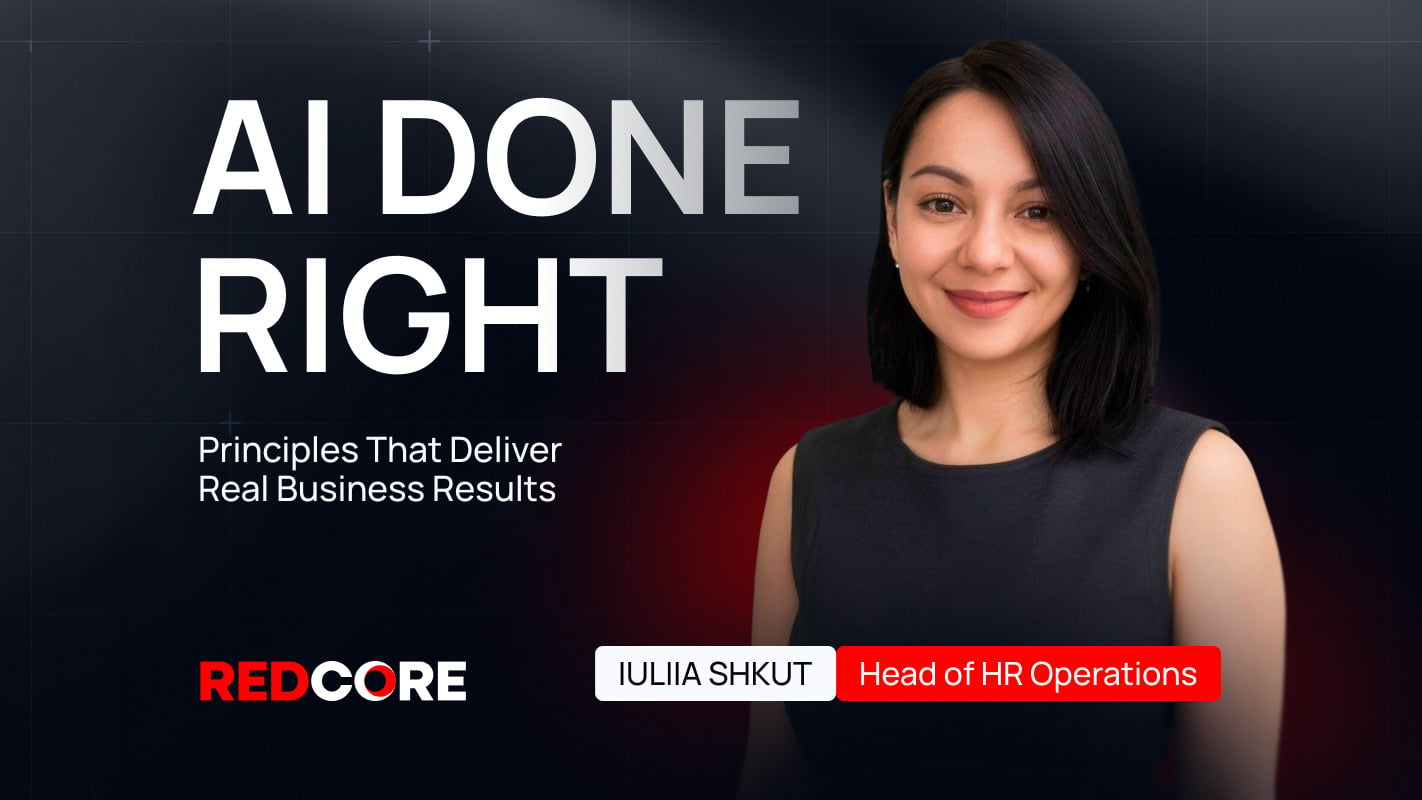
In this article, Iuliia Shkut, Head of HR Operations at RedCore, explores how companies can turn AI and automation into real business value by focusing on practical solutions, human-centered implementation and measurable results.
Implementing AI isn’t the problem. Getting real results from it is.
I don’t think there are companies left that haven’t experimented with AI and automation or tried to simplify their processes with these tools. But not all of them manage to turn these technologies into real business value.
So what’s the problem? The approach.
According to Deloitte research, 59% of companies choose the tool first and only then try to fit it into their existing processes. As a result, they are 1.6 times more likely to fall short of the expected return on investment.
But the picture changes when there is a clear understanding that people manage technology – not the other way around. Companies that use a humancentered approach when implementing new tools are almost 2.5 times more likely to achieve stronger financial results and twice as likely to say that technology genuinely helps people work more effectively.
What fundamentally distinguishes these approaches? Just one question. And it isn’t, “Which tool should we implement?” It’s, “What business problem are we trying to solve?”
This is how we work at RedCore. Today, I’d like to share the principles we follow when implementing new technologies, as well as the products that have delivered real results for our business.
Technology should answer questions, not create them
We never implement technology simply because everyone in the market is talking about it. Every new tool goes through the same filter: “What business outcome will this deliver?” and “How will it help specialists?” If there is no answer to even one of these questions, then we simply don’t need it.
For example:
Our specialists used to spend part of their workday searching for internal documents, policies, and guidelines. The solution was an AI assistant connected to our corporate knowledge base. It works like a GPT Сhat: a specialist asks a question and receives a concise answer along with a link to the original source if they need to explore the topic in more detail.
At the same time, the assistant understands who is asking the question. A manager, a recruiter, and a specialist will receive different answers because each role has its own level of access to information.
For teams, this means getting answers quickly. For the business, it means faster internal processes and confidence that decisions are being made based on a single, up-to-date source of information.
Automate monkey jobs. Elevate human Wwork.
We follow one simple rule: every automation solution should free up at least 20% of working time. And there’s an important distinction here: working time, not personal time. That time shouldn’t simply become a longer lunch break. It should create space for initiative and better decision-making that previously just didn’t fit into the working day.
For example:
We’ve automated candidate profile processing during the hiring process.
Step one: the CV. AI analyzes information from LinkedIn, transfers it into our internal systems, and matches the candidate’s professional experience with our requirements.
Step two: the interview. If a candidate grants us a permission to record the interview, AI automatically transcribes it, analyzes the responses, and uses the same approach to compare them against a predefined role profile.
As a result, this significantly reduces attrition and improves hiring quality. Recruiters no longer spend hours copying and pasting information from CVs into internal spreadsheets. Instead, interviews become more structured and meaningful, giving specialists significantly more time to evaluate each candidate thoroughly and identify experts who are the best fit for the RedCore business group.
AI should improve decision quality, not just decision speed
As a business grows, it’s not just the number of brands, people, and processes that increases, but the cost of making the wrong decision grows as well. That’s why, for us, AI is first and foremost a tool that expands our angle of view. It brings information together, matches the facts, structures data, and helps us find the needle in the haystack, the one that could become the Achilles’ heel of our processes and ultimately cost the business both time and money.
For example:
To make sure nothing goes unnoticed, we also use AI during Performance Reviews to analyze the results of 360° feedback. It compares each specialist’s goals with feedback from respondents, identifies strengths and development areas, and generates recommendations for managers that serve as the foundation for further discussion.
Very often, during the evaluation process, specialists provide feedback not only about one another, but also about the processes they deal with every day. AI analyzes these comments, identifies recurring patterns, and helps uncover systemic issues that are difficult to detect when reviewing individual pieces of feedback. This enables the business to keep its finger on the pulse and review or improve processes at the right time.
The best technology is invisible
Any automation loses its value if it becomes a separate process in itself, one that requires an 80-hour training course just to use. That’s why we strive to bring everything together into a single, intuitive, and user-friendly system that becomes a natural extension of everyday work rather than creating new barriers to getting things done.
For example
We’re developing our own HRMS “Cabinet”, using vibe coding, which allows us not only to significantly accelerate performance but also to quickly introduce changes and adapt processes to evolving business needs.
Initially, it was designed as a unified workspace for managers, bringing together all the key HR processes for their teams: hiring status, performance reviews, vacations, and other tasks that require managerial attention. But thanks to its simple, intuitive, and gamified interface, the system has quickly grown beyond its original purpose. Today, specialists can independently track their development profile, request vacation, and plan day-offs.
As a result, we have a single digital workspace where the number of manual operations is approaching zero, process transparency continues to improve, and managers can devote more attention to what matters most: people and achieving business goals.
Today, the main question is no longer whether to implement AI. The market has already made that decision for us. The only question is whether AI will become just another tool in your tech stack or a true driver of your business’s efficiency.
I hope that RedCore’s experience and real examples from our practice will help you turn technology into a source of real business value as well.
Original article: https://www.yogonet.com/international/news/2026/08/11/125843-modern-hr-technologies-what-actually-works-in-practice-at-redcore