








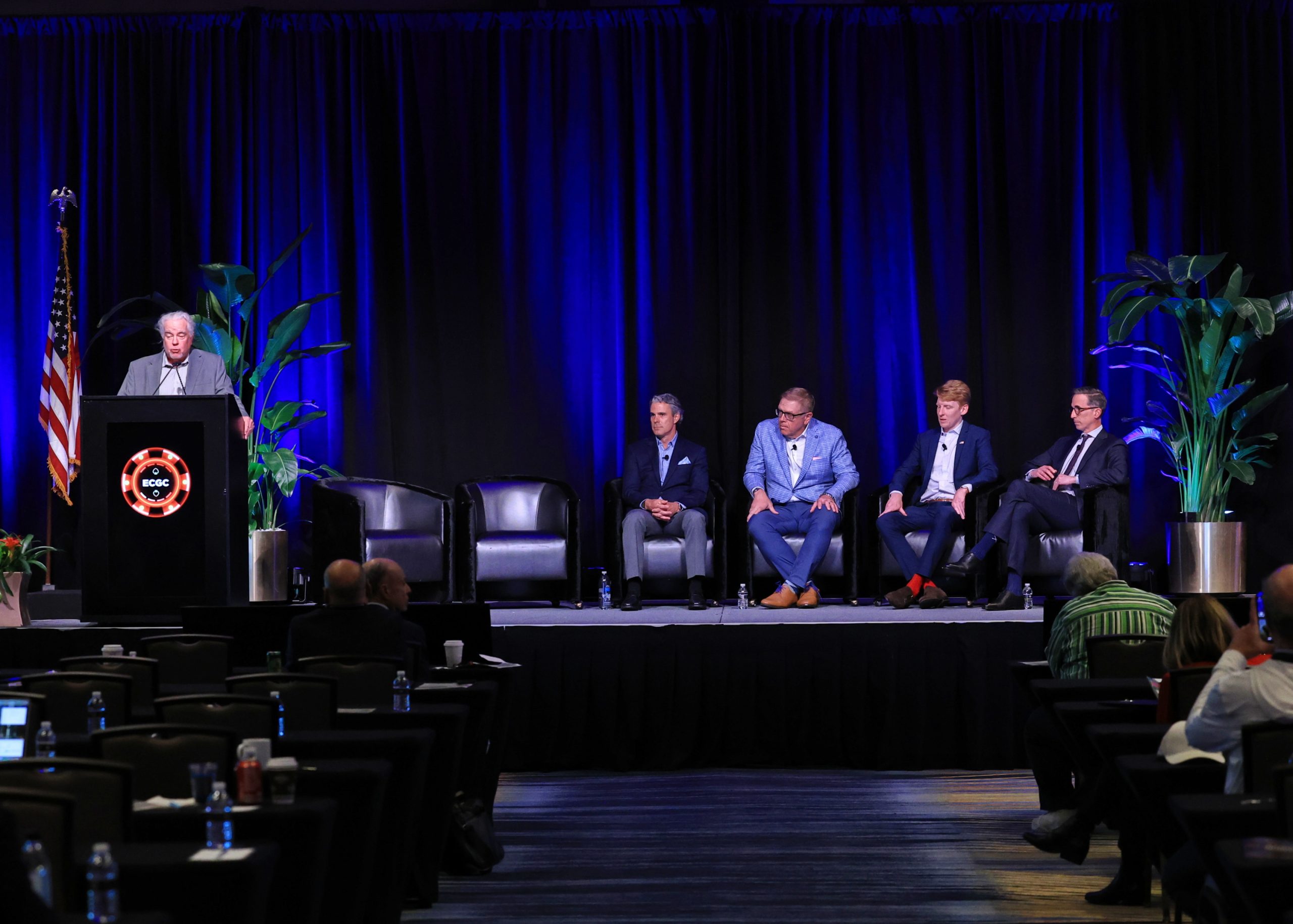
The 29th edition of the East Coast Gaming Congress (ECGC) featured two governors, top regulators from several states and high-level gaming operations executives. They converged on Hard Rock Atlantic City 14-15 April to discuss the challenges and opportunities of the Eastern casino market.
The event, which is the longest-running gaming conference in the US, covered a wide range of hot-button topics. They included how the coming downstate New York casinos will affect Atlantic City, the future of Atlantic City itself as a destination, the state of US iGaming, the emerging use of artificial intelligence and keynote presentations by current New Jersey Governor Mikie Sherrill and former Governor Chris Christie.
At the main keynote luncheon, ECGC awarded its Lifetime Achievement Award to an organisation for the first time, honouring the Association of Gaming Equipment Manufacturers. AGEM President and CEO Daron Dorsey accepted the award.
The theme of the conference was “Gaming in Transition”. It highlighted the changing nature of the Eastern gaming landscape as challenges come from new competition – not only from new regulated casinos in New York, but from emerging forms of unregulated gaming such as sweepstakes casinos, so-called “skill games” and fast-growing prediction markets.
The primary threat
Of those three, the threat from an increasingly capitalised prediction-market industry dominated discussion across much of the educational programme. The subject of how the casino industry can deal with what several panellists called the “existential threat” posed by predictions trading markets came up in several panel discussions in the conference, as well as several of the “Industry Leader” presentations from top industry executives.
The overarching opinion expressed was that prediction markets are essentially illegal sportsbooks. Regulated by a federal commodities oversight agency, the Commodity Futures Trading Commission (CFTC), they began taking trades – predictions on the outcome of certain events – on the prices of commodities, but over the past few years began accepting predictions on political events and even the Iran war, with hundreds of thousands of dollars won on what many suspect involved insider trading.
But what nearly every industry panelist said at the conference was that when prediction markets such as Kalshi and Polymarket began taking bets on sporting events – including props on balls and strikes in baseball, NFL touchdowns, even offering parlay wagers – they crossed the line and became illegal sportsbooks, operating nationally, even where sports betting is banned. Many panelists predicted the next logical step is a slot machine based on prediction outcomes.
Nowhere was the overall threat to casinos from prediction markets more eloquently expressed than at a featured panel on the first day of the conference. Moderated by Roger Gros, editor-at-large of Global Gaming Business, the panel featured both sides of the prediction market issue.
Panellists included Mike Dreitzer, chairman of the Nevada Gaming Control Board and a vocal opponent of prediction markets. He got into a spirited debate with Alex Kane, CEO and founder of Sporttrade, a predictions “marketplace” that takes sports bets. The remainder of the panel was decidedly anti-predictions: Penn Entertainment Senior Vice President Eric Schippers and Joe Maloney, president and CEO of the Sports Betting Alliance.
Kane defended the prediction/exchange model as analogous to traditional commodities futures transactions, in that what appears to be sports wagers are “peer-to-peer” trades, with Sporttrade or Kalshi assuming the role of the broker. “It’s also called the all-to-all market…. Multiple participants are able to do the exact same types of things.”
Dreitzer responded by noting that the exchange concept doesn’t change the fact prediction markets are gambling. “When you risk money for the uncertain outcome of a sporting event, that’s gambling,” he said. “Taking away the word salad around prediction markets, it’s gambling. And fundamentally, it has to be fair.”
He pointed to the absence of KYC policies, anti-money laundering efforts and responsible gambling safeguards in the prediction markets.
Prediction markets follow ‘no rules at all’
“Art the end of the day,” added Schippers from Penn Entertainment, “the public gets the joke. A recent poll reported by the Las Vegas Review-Journal found that 81% of the public recognises that this is gambling that’s going on…. The consumer understands that this is another form of gambling.
“It’s tough to compete against somebody that plays not only by a different set of rules, but by no rules at all. You’re not paying taxes, you’re not worried about marketing to underage kids. You are doing a blitzkrieg of biblical proportion during March Madness out there without any responsible gaming messages.”
Several panellists also pointed out that the prediction markets have spread nationwide and take sports bets where sports betting is illegal, even in states like Utah where all gambling is illegal.
“Here is a product that has been declared unlawful in civil jurisdictions. Yet across the country, you’re still seeing ads that say that this is lawful in every jurisdiction,” said Schippers. “Consumers are bombarded with advertisements.”
Most of the panellists pointed out that prediction outcomes are easily transformed into numerical patterns that can mimic those of slot machines, as Class II and historical horse racing machines now do. So the next logical step will be to add slot games to the prediction sites.
Dreitzer said the prediction companies are building up a war chest of untaxed profits and growing their businesses quickly, aiming to become “too big to fail” by the time the issue is decided, ultimately, by the US Supreme Court.
The issue of prediction markets appeared in several of the other conference sessions, which examined a wide range of challenges and opportunities for the East Coast market.
The coming of AI
The first panel of the conference examined the potential and proven benefits of artificial intelligence as applied to marketing and player development in the casino industry.
Moderated by Scott Nicholson, senior vice president of strategy and partnerships for gifting solutions provider Imagine This, the panel featured Chris Marcello and Michael Glauser, founding partners of of AI specialist FirstPoint Connect.
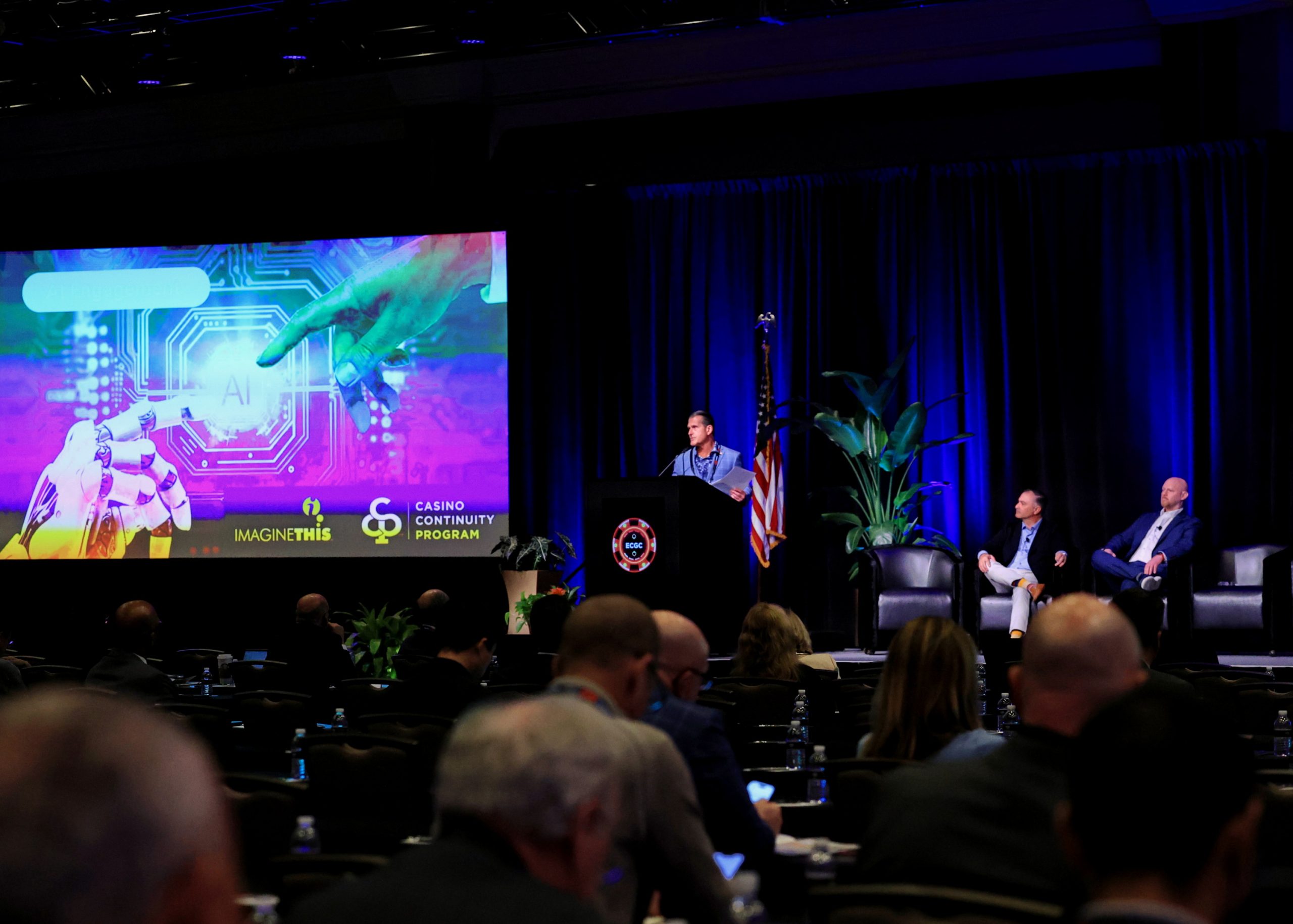
Nicholson touted the ability of marketing aided by AI to fill empty seats in the casino by “having one-to-one conversations with all of your customers.” For gifting events, tournaments and other events, that means personalised texts first inviting, then periodically reminding guests of an upcoming event, all the way up to the event date.
When invitations to events were the only communication related to those events, if not acted upon immediately, it was often forgotten. “People forget; your messaging is not top-of-mind,” Nicholson said. “In today’s world, if you’re not doing constant communication, you’re basically invisible.”
Nicholson demonstrated an AI character named “Oliver” that can handle 75% of the questions asked by customers. “That frees up staff for higher-level human interaction,” he said.
Marcello and Glauser showed the practical ways AI has been used in marketing, including a programme at Casino Del Sol in Tucson, Arizona that compared results of a promotion marketed using AI with pre-AI promotions. With a call to each customer the week of the event and a text the morning of the event (languages can be specified), there was a 17% jump in participation, with 30% higher theoretical win from participants and a 30% increase in gaming hold for the month.
Regulation in transition
A distinguished panel of regulators, moderated by Lucas Levenson of Cooper Levenson law firm, examined the continuing battle against illegal gaming, highlighted by continuing enforcement efforts, particularly those targeting illegal online casinos. The panel featured top regulators from five different states.
Kevin O’Toole, executive director of the Pennsylvania Gaming Control Board, noted the state’s development of problem gaming protections has been applied equally to brick-and-mortar and online gaming operations in the state. “The tools we use to minimise problem gambling can apply to land-based as well as online,” he said, noting that the self-exclusion and self-imposed limits options have been used by 5.5% of all iGaming accounts, or more than 30,000 people. “We’ve tried to make it very easy for online players to access responsible gaming assistance,” O’Toole said.
Several panellists described efforts to combat illegal gambling. Mary Jo Flaherty, interim director of the New Jersey Division of Gaming Enforcement, cited New Jersey’s law prohibiting sweepstakes gambling, which gave the Division of Gaming Enforcement “broad enforcement powers” not only over illegal sweepstakes casinos, but over all forms of illegal gambling, which would include prediction markets as well as illegal offshore online casinos.
Flaherty noted that an important part of New Jersey’s fight against illegal gaming is the requirement that all regulated online gaming be conducted through land-based licensees.
Alana Zimmer, executive director of the Florida Gaming Control Commission, said the state’s regulators are currently working with the legislature to increase penalties for illegal gambling, which is a misdemeanor in the state, punishable by less than six months in jail and a relatively small fine. Kurt Steinkamp, chief of staff at the Michigan Gaming Control Board, relayed the success of a cease-and-desist letter campaign, with more than 250 letters sent to unregulated internet gaming sites, which he called a “great start” to dealing with the illegal gambling in the state.
Casinos and lotteries
A panel of lottery officials moderated by New Jersey Lottery Executive Director James Carey examined how casinos and lotteries have ceased to be adversaries and can work together for the benefit of both gaming channels.
Carey noted that the New Jersey Lottery and the Atlantic City casino industry were never considered adversaries. “We’re not competing,” he said. “The offers are completely different. Lottery profits are devoted to public benefits. We exist in our own space.” He said lotteries are transactional, whereas casinos are experiential.
Michael Pollock, senior policy advisor for Spectrum Gaming Group and one of the founders of ECGC, said, “I reject the notion that casinos and lotteries compete against each other.” In fact, he said, lotteries and casinos can work together to the benefit of both, with possible programmes where lottery purchases generate points in casino loyalty clubs, with awards to be redeemed on-property.
“New Jersey can be a pioneer in creating a master plan for gaming that includes both casinos and lotteries,” Pollock said.
“Nothing happens without cooperation,” said Bishop Woosley, former director of the Arkansas Lottery, who pointed to DraftKings’ purchase of lottery courier service Jackpocket, combining lottery sales, casino gaming and sports betting on a single app. Carey noted that the addition “turned sports bettors into lottery players,” not the other way around.
The predictions issue also was part of the lottery discussion. Paul Sternburg, a vice president of UK lottery operator Allwyn and former director of the Massachusetts Lottery, called prediction markets “the biggest threat to lotteries.” He said polls have shown players spend less on lotteries where prediction market are introduced.
The East Coast challenge
The final panel of the conference examined the challenges facing the East Coast gaming market in the near term. Moderated by Jacques Cornet of ICR Capital, the panel included the current president of the Casino Association of New Jersey, Hard Rock Atlantic City President George Goldhoff; and the immediate past president, Resorts President and CEO Mark Giannantonio.
The challenges discussed were meeting the coming competition from New York City casinos, the renewed proposal of casinos in North Jersey, and the revitalization of Atlantic City itself.

The New York discussion was aided by Kevin Jones, chief strategy and legal officer for Genting Americas, parent of Resorts World New York City, one of the downstate licensees. The North Jersey argument was aided by Dennis Drazin. Drazin is chairman and CEO of Monmouth Park, one of the properties that would benefit from slots and other casino games. Goldhoff and Giannantonio discussed what needs to be done to keep Atlantic City competitive in an increasingly crowded market.
Jones downplayed the potential adverse affect on Atlantic City, at least of Resorts World, which is adding tables and resort amenities to an established slot business. He said Resorts World is “adding to an existing base,” and will continue to reach out to the 19 million gambling-age adults in the immediate New York region.
“We’re quintessential New York boys, but we’re not a regional player,” Jones said. “The reality is we get an immaterial amount of business from across highways. We get Queens and Brooklyn. This is a way to penetrate Manhattan in a way we haven’t to date.”
Monmouth Park CEO Drazin said parimutuel racing in North Jersey needs casino gaming to survive. He suggested a partnership with Atlantic City casinos, in which current licensees would share revenues with current casinos. (Gaming anywhere outside Atlantic City would require an amendment to New Jersey’s constitution.)
Goldhoff and Giannantonio said the way to meet new challenges is a concerted effort to refurbish Atlantic City itself. That means a public/private partnership to demolish abandoned buildings, add amenities and generally transform the city into the long-promised true destination resort.
“We’ve got to revitalise Atlantic City and do it now,” Giannantonio said. “I believe we can grow the market by 30%-40%.”
Gaming leaders speak
Governor Sherrill, in her keynote remarks, essentially repeated those concerns over the shabby condition of much of Atlantic City’s tourist district, and promised that the state will do its part to revitalise the city.
For most of the industry leader presentations, though, the subject invariably returned to the threat posed by the growing prediction market, beginning with a presentation in which American Gaming Association President and CEO Bill Miller interviewed Christie, the former New Jersey governor, who was instrumental in the years-long fight leading to the US Supreme Court decision to overturn the federal ban on sports betting.
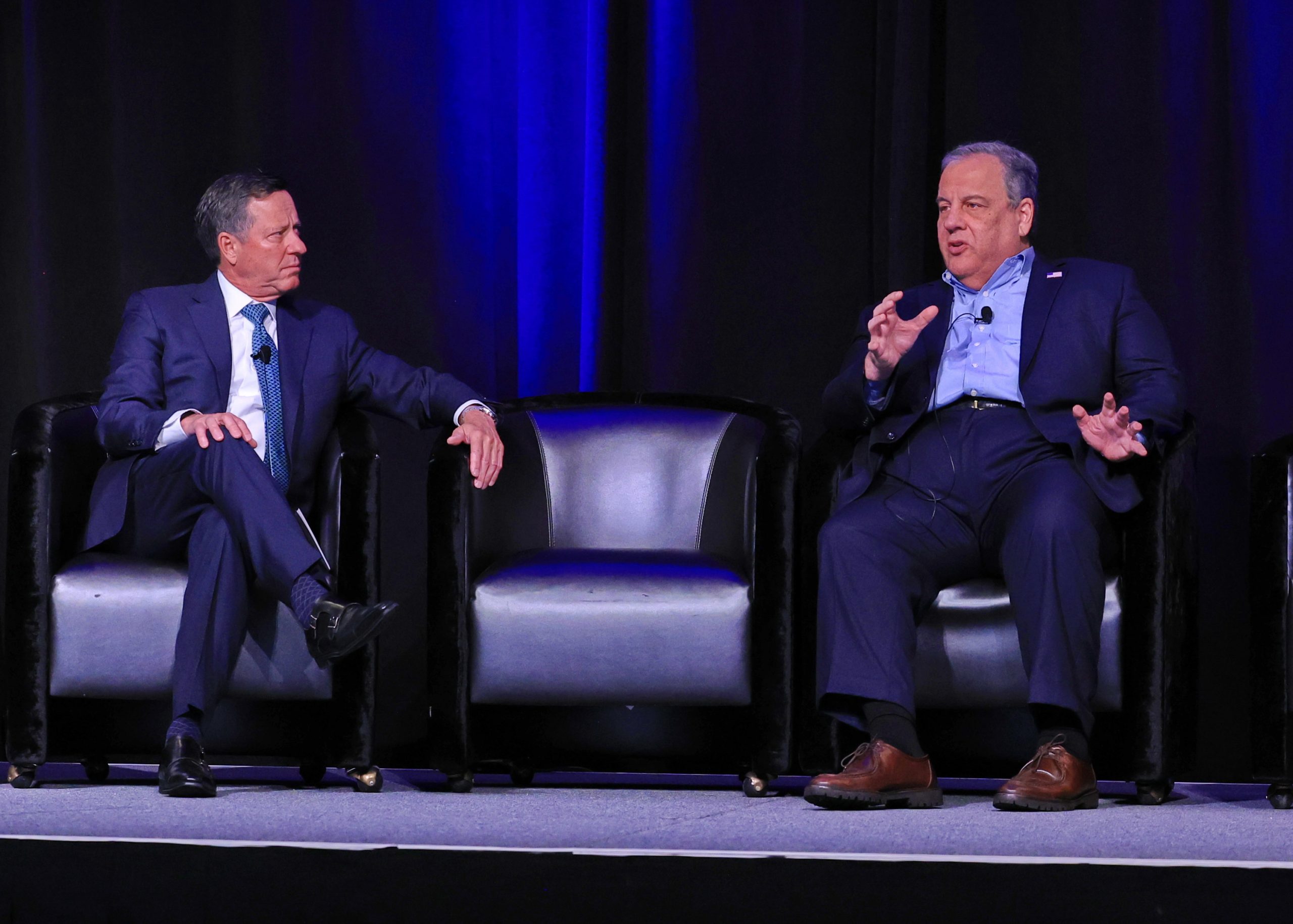
Christie said the initial motivation for the state law that legalise sports betting was to help Atlantic City casinos with sportsbooks. “I didn’t know it would take six years of litigation” to arrive at the Supreme Court decision overturning the Professional and Amateur Sports Protection Act, he said.
Christie likened the PASPA fight to what is currently happening with prediction markets. He said that prediction markets taking sports bets in states where it is outlawed, based on their federal regulatory structure, poses the same states’ rights issue that was at the center of the PASPA fight. He said the issue will be resolved by the US Supreme Court, the sooner the better.
Both Miller and Christie emphasised the danger to the industry inherent in the predictions trade. “They market to teenagers,” said Christie. “Think of the effect on someone without the means or the maturity to gamble responsibly. It’s (creating) a new problem, and providing no assistance.”
Among the industry leaders noting the prediction problem were Jay Dorris, president and CEO of the Poarch Band’s PCI Gaming Authority. He cautioned that prediction markets “borrow trust” from the regulated gaming industry. “If borrowed trust is broken, regulated gaming will pay the price,” he said.
Penn Entertainment CEO Jay Snowden did a presentation asking AI bots questions to illustrate the ridiculous nature of the prediction markets’ claim to legality. (Q: “Is sport betting a commodity?” A: “Sports outcomes are not commodities in any traditional sense.”)
Cordish Companies Chairman David Cordish, as usual, devoted his presentation to his long-held position that all internet gaming harms brick-and-mortar casinos. This year, he added prediction markets to the list. Cordish said they join iCasino, mobile sports betting and sweepstakes sites as ongoing threats to brick-and-mortar gaming.

Frank Legato
Frank has been writing on gaming topics since 1984. He has served as editor and reporter for a variety of gaming publications, including Public Gaming, IGWB and Casino Journal.
Original article: https://igamingbusiness.com/casino/gaming-in-transition-east-coast-gaming-congress-takes-on-ai-prediction-markets-new-competition/