








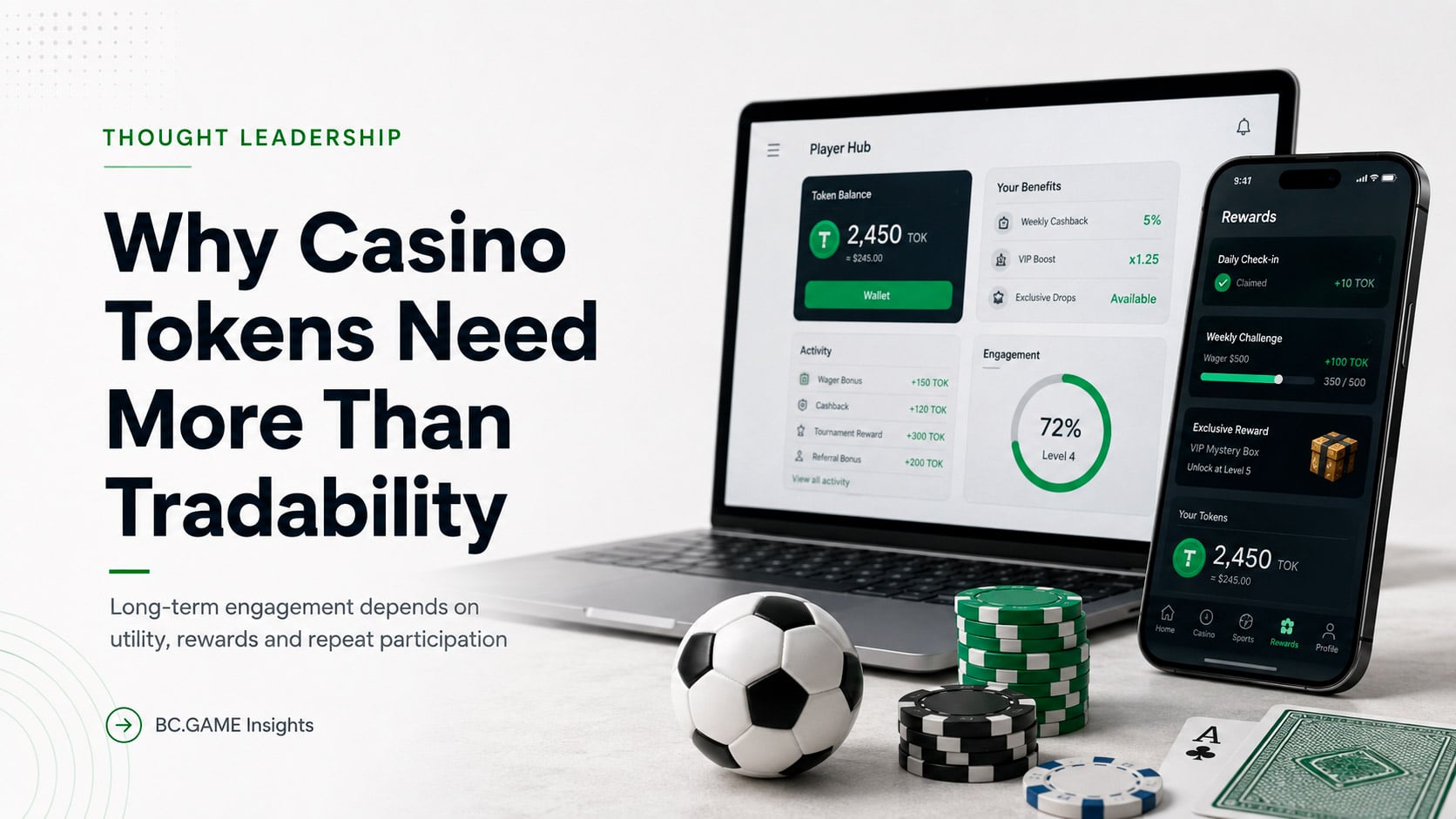
In this article, BC.GAME explores how token utility can move beyond tradability to create sustained user engagement within crypto gaming ecosystems.
For years, crypto-native gaming platforms have treated tradability as one of the defining features of a token.
A token can be listed, transferred, bought, and sold. It can develop a market price, generate speculation and, in some cases, create a new acquisition channel for the platform behind it.
But tradability alone does not necessarily create engagement.
For gaming operators exploring token-based ecosystems, that distinction is becoming increasingly important. A liquid token may attract attention, but long-term participation depends on whether users have a reason to interact with that token after the initial transaction.
The bigger question for the industry is therefore shifting from “Can users trade the token?” to “What can users continuously do with it?”
The limit of a transaction-first token model
Tradability solves one part of the token proposition: liquidity.
It gives users a way to enter or exit an asset and allows market forces to establish a price. For crypto users, that functionality is expected.
But from an engagement perspective, trading is often an activity that takes place outside the core platform experience.
A user can buy a token, hold it in a wallet, or trade it on a secondary market without meaningfully interacting with the product that issued it.
That creates a structural gap.
The platform may have succeeded in creating a tradable asset, but it has not necessarily created a reason for the user to return.
This is particularly relevant in online gaming, where the underlying product already operates within a highly competitive attention economy. Players have access to thousands of games, multiple operators and increasingly similar promotional offers.
If a token is expected to strengthen the relationship between a platform and its users, it needs to become part of that relationship rather than simply an asset associated with the brand.
Utility has to be repeated, not theoretical
Token utility is frequently discussed in broad terms: access, governance, rewards, staking or payments.
The more important question is whether that utility creates repeatable behaviour.
A useful token mechanism should ideally give users a reason to interact with the ecosystem more than once.
That could mean participation in a reward system, access to platform features, contribution to an internal economy or another mechanism where holding and using the token connects directly with the underlying product.
BC.GAME’s BC Engine provides one example of how this model can develop.
Rather than positioning BC purely as a tradable crypto asset, the Engine connects the token with an ongoing rewards mechanism inside the platform ecosystem. Users place BC into the Engine, while BCD rewards generated through the system are distributed over time.
The significance is not simply that rewards exist. It is that token participation becomes an ongoing activity rather than a single transaction.
Recent platform data illustrates how that behaviour has developed.
Between April and July 2026, the number of participating accounts increased from 187,931 to 449,009, representing growth of approximately 138.9%.
During the same period, the amount of BC held within the Engine increased from approximately 601.7 million BC to more than 1.22 billion BC, an increase of roughly 103.2%.
Across those four months, the Engine distributed more than 5.24 million BCD, with approximately 1.72 million BCD distributed in July alone — the highest monthly level during the period.
These figures do not by themselves prove higher player retention, increased deposits or greater betting activity. Establishing those relationships would require separate behavioural analysis.
What they do show, however, is sustained participation in a token utility mechanism beyond simple market trading.
And that distinction matters.
The token becomes part of a system
The strongest crypto ecosystems tend to treat the token as one component of a wider system rather than as the product itself.
For casino tokens, this may be particularly important.
Gaming platforms already generate continuous economic activity. Players interact with casino games, sportsbooks, rewards systems, promotions and other platform products every day.
A token ecosystem can potentially connect those activities.
BC EngineBC EngineBC.EngineBC.Engine, for example, links BC participation with rewards generated from activity across parts of the BC.GAME ecosystem. That changes the role of the token.
Instead of existing only as something users can trade, BC becomes a mechanism through which users can participate in the economic activity surrounding the platform.
This creates a very different engagement loop:
platform activity creates value → token participation provides access to that value → rewards create another reason to remain engaged with the ecosystem.
The important word is loop.
A tradable token creates a transaction.
A functional token ecosystem can create repeated interaction.
Engagement is more valuable than short-term attention
Crypto markets naturally place enormous attention on price.
For token issuers, this creates a temptation to evaluate success through trading volume, market capitalization or short-term price movement.
Those metrics matter, but they measure market behaviour more than product engagement.
For gaming platforms, a different set of indicators may ultimately be more useful.
How many users are participating in the token ecosystem?
Is participation expanding over time?
How much of the token is being used within platform mechanisms?
Are rewards being continuously generated and distributed?
And, eventually, does participation correlate with longer user lifecycles or deeper engagement with the product?
BC Engine’s April-to-July figures offer an early illustration of this distinction.
The growth from fewer than 188,000 participating accounts in April to nearly 450,000 in July suggests that users are not interacting with BC exclusively through secondary-market trading.
At the same time, more than 1.2 billion BC being held within the Engine indicates that a meaningful portion of token activity is taking place inside a product-specific utility layer.
For operators, this type of behaviour may ultimately be more strategically important than temporary increases in token visibility.
Casino tokens are moving into their next phase
The first generation of gaming tokens largely borrowed its logic from the broader crypto market.
Issue the token. Create liquidity. Pursue listings. Build a community around the asset.
The next generation will likely need to go further.
Gaming companies have an advantage that many token projects do not: they already have products, users, and recurring economic activity.
The opportunity is to connect those elements.
That means designing token systems where utility grows alongside the platform rather than existing separately from it.
It also means judging token performance differently.
Price can tell operators what the market thinks about an asset at a particular moment.
Participation can tell them whether users are actually finding a reason to use it.
For casino tokens seeking long-term relevance, that second question may prove much more important.
Tradability can create attention.
Utility creates reasons to stay.
Original article: https://www.yogonet.com/international/news/2026/08/13/125840-why-casino-tokens-need-more-than-tradability-to-build-longterm-engagement